

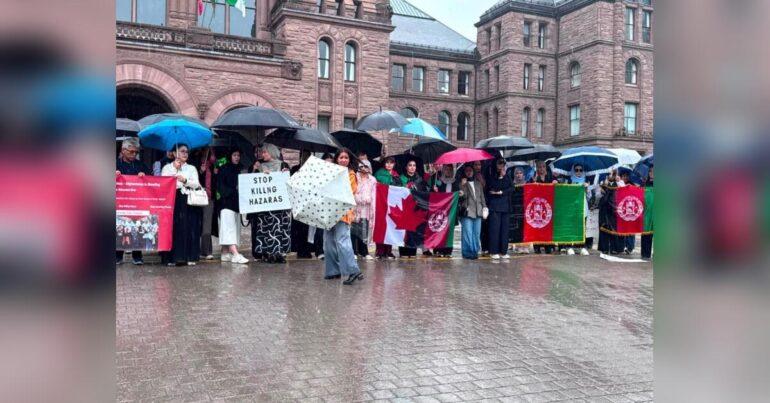

KABUL, AFGHANISTAN – A number of Afghan migrants gathered in a protest rally in Toronto, Canada, calling on the international community to recognize “gender apartheid” and the “genocide of Hazaras” in Afghanistan.
During the rally, which was held yesterday (Sunday, June 14), participants expressed their solidarity with Afghan women and girls, particularly the women of Herat. They condemned the suppression of protesters in Herat and voiced their opposition to widespread human rights violations, structural repression, and gender apartheid in Afghanistan.
According to the protesters, Afghanistan is currently facing a deep human rights crisis in which women and girls have been deprived of their most basic rights, including education, employment, freedom of movement, social participation, and presence in public life.
A resolution issued during the protest stated that this situation constitutes a clear violation of human rights principles and an organized effort to exclude half of society from public life.
The protesters said that they strongly condemn the misogynistic and discriminatory policies that have deprived Afghan women of their fundamental human rights. They called for the recognition of gender apartheid against Afghan women as a crime against humanity under international law.
The demonstrators also demanded the immediate reopening of schools, universities, and all educational institutions to Afghan girls and women, as well as the full protection of their equal rights. They emphasized that education, work, freedom of expression, freedom of movement, and social participation are fundamental and inalienable rights of all human beings.
They also expressed deep concern over “structural discrimination, targeted violence, land confiscations, and military pressure in areas such as Panjshir and Andarab, as well as deadly and systematic attacks against the Hazara community in educational and religious institutions.”
The protesters called on the international community and human rights organizations to recognize the “genocide of Hazaras” and to take immediate action to stop it.
They stressed that “confronting these injustices and standing against them is a vital and fundamental necessity for ensuring human rights, justice, and equality in Afghanistan.”
Participants in the protest rally urged the United Nations, the Canadian government, democratic states, and human rights organizations not to remain silent regarding the situation in Afghanistan. They also called for practical measures, effective diplomatic pressure, accountability mechanisms, documentation of crimes, and direct support for victims.
The term “Hazara genocide” is used by some activists and members of the Hazara community to describe the pattern of long-term and repeated violence, persecution, and targeted attacks against Hazaras in Afghanistan. This includes historical massacres, forced displacement, and more recent incidents of bombings and assaults targeting Hazara-populated areas, schools, mosques, and public gatherings.
Many argue that these acts are not isolated events but part of a broader and systematic pattern of ethnic and religious discrimination against the Hazara community, who are predominantly Shia Muslims in a country where they have often faced marginalization. Human rights advocates call for independent investigations into these attacks and for stronger international protection mechanisms, while emphasizing the importance of accountability for those responsible and the need to ensure the safety and equal rights of Hazaras in Afghanistan.
Last week, the Taliban intensified restrictions and detained dozens of women in Herat Province in western Afghanistan on allegations of failing to comply with the dress code imposed by the group.
The latest protest followed an initial demonstration on June 9 in Herat’s predominantly Hazara-populated Jibrail Neighbourhood, which erupted after days of mounting public anger over the detention of women. During that protest, Taliban forces reportedly opened fire directly on the crowd and beat demonstrators, killing at least one child and injuring around 20 others, according to local sources and videos.
Following the first protest, the Taliban deployed hundreds of armed fighters equipped with light weapons, rockets, and tanks across Herat and set up multiple checkpoints on major routes. Similar security measures were implemented in Kabul’s Dasht-e-Barchi, a Hazara-populated neighbourhood in western Kabul, where large numbers of troops and military vehicles were positioned to head off potential unrest. No protests were reported in Kabul as of Friday evening.
The Taliban’s use of force against peaceful demonstrators and the detention of women and girls have also drawn strong international condemnation. The United Nations, human rights organizations, politicians, and citizens worldwide have called on the group to stop the violence against peaceful protesters and immediately release all detained women and girls.
Since the Taliban’s return to power, Afghan women have been increasingly restricted from education, employment, freedom of movement, and participation in political and social activities. These policies have created a situation where women are largely confined to the private sphere and denied equal access to basic human rights enjoyed by men. Human rights advocates and international organizations argue that such systematic exclusion is not only discriminatory but also structured and enforced at a societal level, meeting the criteria of what many are now calling “gender apartheid.”
The protest in Toronto was part of a broader wave of demonstrations organized by Afghan diaspora communities around the world in response to recent developments in Afghanistan. Participants said that continued international attention and solidarity are essential to supporting the rights of women, ethnic and religious minorities, and all those affected by ongoing human rights violations in the country.

