

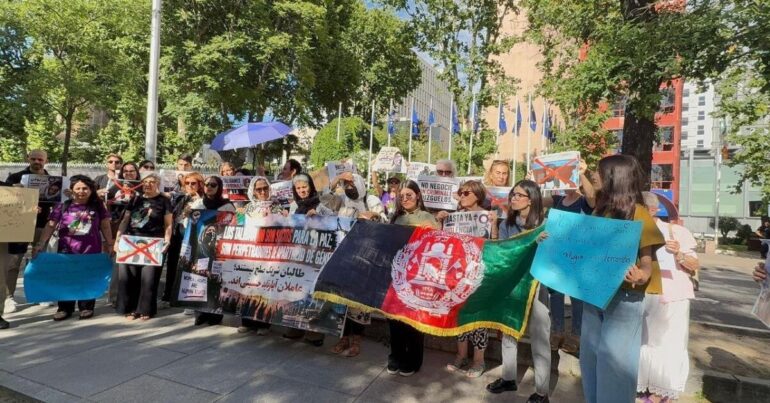

KABUL, AFGHANISTAN – Afghan women living in Spain staged a demonstration outside the European Parliament office in Madrid on Thursday, calling on the European Union to cancel reported plans to engage with Afghanistan’s Taliban rulers.
The protesters, chanting slogans such as “Taliban is not a partner for peace,” “Taliban perpetrators of gender apartheid,” “free Afghan women,” and “stand with Afghan women,” criticized the EU’s reported intention to host a technical Taliban delegation in Brussels.
In a joint statement issued at the end of the protest, the women urged the European Parliament to halt any engagement that could lead to the normalization or legitimization of the Taliban.
“We call on the European Parliament to halt any engagement that contributes to the normalization and legitimization of the Taliban and to stand alongside Afghan women,” they said.
They also called on the international community to hold the Taliban accountable for human rights violations rather than offering them a platform, and to focus on ending gender apartheid instead of normalizing it.
Similar demonstrations have been held in several other European countries in recent months, reflecting growing opposition among Afghan diaspora groups to EU engagement with the Taliban.
Reports indicate that the European Commission is preparing to invite a technical Taliban delegation for talks aimed at facilitating the deportation of Afghans whose asylum applications have been rejected or who have committed crimes in European countries.
According to the reports, the talks would focus on practical issues, including travel documents, passport issuance, identity verification, and coordination of deportation flights.
While the EU does not formally recognize the Taliban administration that seized power in August 2021, the reported invitation has sparked sharp criticism from human rights organizations, United Nations experts, Afghan activists, several members of the European Parliament, and media watchdogs.
Critics argue that even limited technical contacts risk legitimizing a regime widely accused of severe and systematic human rights abuses and contradicting EU principles.
Last month, the European Parliament adopted a resolution with overwhelming support opposing any invitation to the Taliban, calling on EU member states to uphold a policy of non-recognition and non-normalization, citing the group’s widespread violations of fundamental rights, especially against women and girls.
Several EU countries, including Germany, Austria, Switzerland, Norway, and the Netherlands, have held meetings with Taliban delegations in the past two years, often to facilitate deportations. Germany has carried out multiple direct deportation flights to Kabul in recent months.
Since taking power, the Taliban have imposed sweeping restrictions that have largely excluded women and girls from public life, including bans on secondary and higher education and severe limits on work, movement, and civic participation. UN experts and legal scholars have described the measures, taken together, as potentially amounting to gender persecution as a crime against humanity.

