

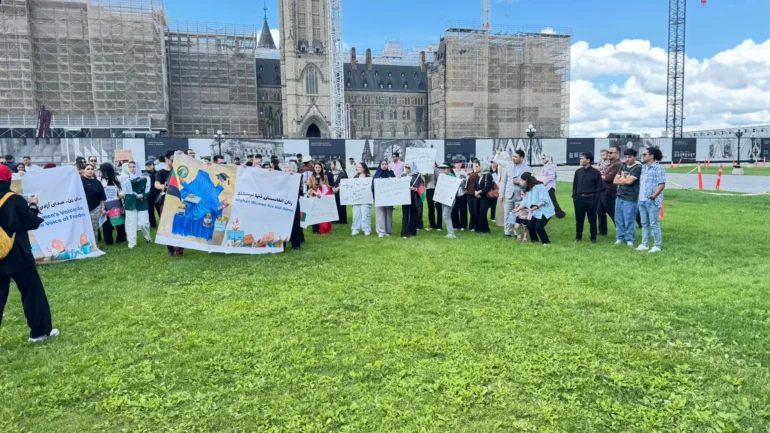

KABUL, AFGHANISTAN – Dozens of Afghan migrants living in Canada held a protest rally in Ottawa, calling on the international community to take practical action to support Afghan women and girls.
The protest was held on Sunday (June 21) in front of the Canadian Parliament.
The organizers of the demonstration issued a resolution calling on the international community to take “practical, urgent, and effective measures” to support women and girls in Afghanistan.
They urged the international community, particularly the Canadian government, to use all legitimate political and legal tools to compel the Taliban to respect human rights, women’s rights, and international obligations.
According to the protesters, “today, millions of women and girls in Afghanistan are deprived of their most basic human rights, not because they have committed any crime, but solely because they are women.”
The Afghan migrants referred to the Taliban’s violent suppression of a civil and advocacy gathering of women in the Jebrail township of Herat and said that such actions are part of a “systematic and targeted double oppression” against women.
The protesters called for the recognition of “gender apartheid” in Afghanistan and expressed concern over “efforts by parts of the international community to recognize the notorious Taliban regime.”
They emphasized that “silence in the face of oppression, neutrality in the face of discrimination, and appeasement of human rights violators lead neither to peace nor stability, but rather to the expansion of injustice, suffering, and the torture of many people.”
The latest protests followed an initial demonstration on June 9 in Herat’s predominantly Hazara-populated Jibrail Neighbourhood, which erupted after days of mounting public anger over the detention of women. During that protest, Taliban forces reportedly opened fire directly on the crowd and beat demonstrators, killing at least one child and injuring around 20 others, according to local sources and videos.
Following the first protest, the Taliban deployed hundreds of armed fighters equipped with light weapons, rockets, and tanks across Herat and set up multiple checkpoints on major routes. Similar security measures were implemented in Kabul’s Dasht-e-Barchi, a Hazara-populated neighbourhood in western Kabul, where large numbers of troops and military vehicles were positioned to head off potential unrest. No protests were reported in Kabul as of Friday evening.
The Taliban’s use of force against peaceful demonstrators and the detention of women and girls have also drawn strong international condemnation. The United Nations, human rights organizations, politicians, and citizens worldwide have called on the group to stop the violence against peaceful protesters and immediately release all detained women and girls.
Furthermore, in recent days, Afghan migrants and activists have organized protests in the United States, Iran, Switzerland, Spain, Canada, Germany, and France to express solidarity with women in Afghanistan and condemn the Taliban’s treatment of female protesters. Demonstrators have called for the recognition of gender apartheid in Afghanistan, demanded the immediate release of detained women and girls, and urged the international community to take stronger measures to protect women’s rights and hold the Taliban accountable for ongoing human rights violations. Protesters argue that the crackdown in Herat is part of a broader pattern of repression targeting Afghan women and civil society under Taliban rule.
Since returning to power in 2021, the Taliban have imposed sweeping restrictions on women’s education, employment, movement, and participation in public life. Activists argue that continued international pressure and sustained global attention are essential to preventing further erosion of women’s rights and ensuring that the voices of Afghan women remain at the center of discussions about Afghanistan’s future.
The demonstrations reflect growing concern among Afghan diaspora communities over the continuing erosion of women’s rights and civic freedoms in Afghanistan. Activists argue that sustained international pressure and accountability mechanisms are necessary to address what many human rights organizations have described as systematic discrimination against women and girls under Taliban rule.

