

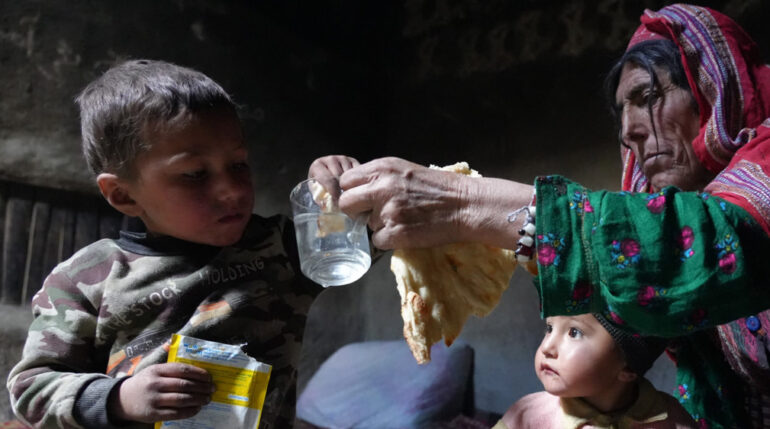

KABUL, AFGHANISTAN – An additional 2.3 million people in Afghanistan could face food insecurity if border closures with Pakistan persist and the Middle East conflict continues to disrupt regional trade and energy markets, the World Food Programme (WFP) warned in a new report.
The report, titled “Food Security Under Pressure: How the Middle East Crisis is Impacting Vulnerable Countries,” said about 13.8 million people in Afghanistan are already struggling with food insecurity. The U.N. agency warned that trade disruptions, rising inflation, and funding shortages could significantly worsen conditions in the coming months.
Afghanistan, which relies heavily on cross-border trade routes for essential imports, has faced repeated disruptions along its border with Pakistan in recent years. The crossings, a lifeline for food, fuel, and aid shipments, have been periodically closed amid political tensions and security-related incidents, driving up transport costs and slowing market supply chains.
Pakistan closed major crossings, including Torkham and Chaman, in late 2025 after a series of border clashes with the Taliban and disputes over the activities of militant groups such as the Tehreek-e-Taliban Pakistan (TTP), which Islamabad says operate from Afghan territory. Further fighting along the frontier in early 2026 continued to disrupt trade and transport between the two countries.
The WFP said the situation is being aggravated by the Middle East conflict, which, since late February, has disrupted shipping through the Strait of Hormuz, a vital route for global oil, gas, and fertilizer exports. The disruption has driven up fuel costs and increased the price of transporting and producing food worldwide.
Afghanistan depends on Iran for roughly 60% of its exports and 50% of its imports. With Pakistan’s border closed and Hormuz routes disrupted, WFP’s external transport costs in Afghanistan have surged 2.5 to 5 times, while delivery times have stretched from 10 days to as long as 75 days using alternative corridors.
“Early warnings only matter if the world acts on them,” said Jean-Martin Bauer, Director of WFP’s Food Security and Nutrition Analysis Service. “We warned that this crisis could push millions more into hunger. We are now seeing it unfold in real time.”
The agency said the poorest households, often far from the conflict itself, are bearing the heaviest burden. Farmers in Afghanistan are entering the planting season amid fertilizer shortages and elevated fuel prices, raising concerns about lower harvests and higher food prices later this year.
The report also assessed the impact on Somalia and Sri Lanka. It is estimated that an additional 2.5 million people in Somalia and 1.3 million in Sri Lanka could struggle to meet their basic food needs if current conditions persist.
Globally, the crisis is straining humanitarian operations. WFP faces rising delivery costs, supply interruptions, and funding shortfalls. If the conflict persists for another six months, WFP said, more than 9 million people worldwide could lose assistance.
The report recommends strengthening market monitoring and food security data systems, scaling up social protection programs with governments, safeguarding critical humanitarian supply chains, and reviewing targeting criteria to include those hit by economic shocks.
“One of the biggest concerns is that the full impact of this crisis has not yet been felt,” Bauer said. “Even if the conflict were to end today, irreversible damage has been done and the impact on prices, livelihoods and humanitarian operations will continue to be felt for a long time.”

