

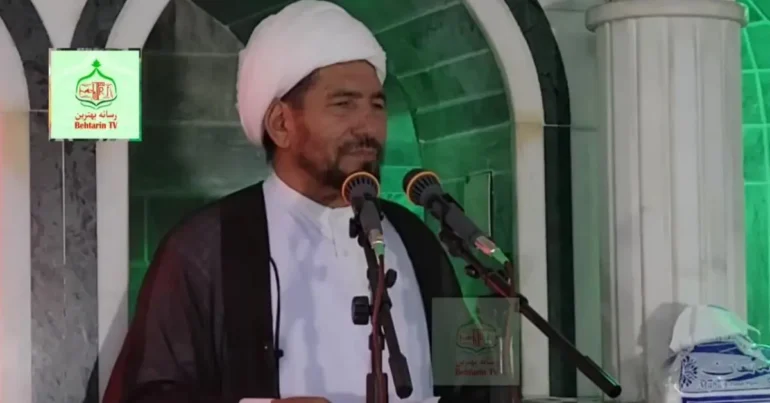

KABUL, AFGHANISTAN – A prominent Shiite cleric in Kabul, Hussain Dad Sharifi, has confirmed that he was summoned to the city’s 18th security district and physically assaulted by Taliban authorities after officiating a temporary marriage contract for a young couple.
Sharifi disclosed the incident during a sermon on Friday, May 15, at a mosque in Dasht-e-Barchi, a predominantly Shiite neighborhood in western Kabul.
According to Sharifi, he was called to the district office after receiving threats from Taliban officials. Upon his arrival, he said he faced intimidation, humiliation, and physical violence.
The confrontation reportedly stemmed from his role in solemnizing a temporary marriage contract, known in Shiite Islamic jurisprudence as nikah mut’ah, for an engaged couple. Under Ja’fari jurisprudence, this form of marriage is legally and religiously valid when conducted under specific conditions, including mutual consent and an agreed duration. It grants both spouses defined legal and religious rights and renders them mahram, meaning they are lawfully permitted to interact privately.
Sharifi explained that the couple had entered into such a contract during their engagement period and were therefore considered religiously married. However, Taliban officers allegedly detained them while they were shopping for wedding-related items, accusing them of maintaining an unlawful relationship.
When Sharifi later went to the security office to clarify the religious basis of the marriage, he said a Taliban official from the Ministry for the Propagation of Virtue and Prevention of Vice dismissed Shiite jurisprudential interpretations, declared temporary marriage invalid, and accused the couple of fornication.
Sharifi said that when he attempted to explain the doctrinal foundations of the practice, he was physically struck, causing his turban to fall, before others present intervened to stop further violence.
He further stated that Taliban officials forced him to sign a written pledge and provide a guarantor, committing not to perform temporary marriages in the future on the grounds that the practice is not recognized in Sunni jurisprudence.
Sharifi also claimed that he saw official records containing the names and biometric data of several Shiite clerics who had allegedly been compelled to sign similar guarantees prohibiting them from conducting temporary marriage ceremonies.
He urged Taliban authorities to clarify whether such actions represent an official policy targeting Shiite religious practices or whether they are isolated abuses by individual officials. He warned that if these actions are systematic, they amount to direct suppression of Shiite religious identity and jurisprudence.
Sharifi also criticized broader restrictions on Shiite participation in public life, arguing that if Shiites are already excluded from meaningful political representation, their private religious affairs should at least remain free from interference.
Five days earlier, local sources in Kabul reported that Taliban officers from the Ministry for the Promotion of Virtue and Prevention of Vice in District 18 had arrested a Hazara engaged couple while they were shopping in Dasht-e-Barchi for their upcoming wedding ceremony.
The couple had been accused of being non-mahram and were transferred to the district security office, where the incident later escalated into the summoning, verbal abuse, and physical assault of Shiite cleric Hussain Dad Sharifi after he attempted to clarify the religious legitimacy of their marriage contract.
Temporary marriage remains one of the most significant jurisprudential differences between Sunni and Shiite schools of Islamic thought. Shiite scholars interpret Verse 24 of Surah An-Nisa as affirming its validity, while most Sunni scholars maintain that the ruling was later abrogated and is no longer applicable. This theological disagreement has existed for centuries and forms part of the broader legal distinctions between the two traditions.
Earlier this week, the High Commission of Shiites confirmed Sharifi’s summons and assault and said it had formally requested that the Taliban’s Ministry for the Propagation of Virtue and Prevention of Vice investigate the matter.
Meanwhile, the incident has prompted criticism from Mohammad Mohaqiq, leader of the Islamic Unity Party of the People of Afghanistan, who described the assault as a serious violation of Shiite religious autonomy.
In a statement published Friday night on Facebook, Mohaqiq argued that personal status laws—including marriage, divorce, inheritance, child custody, and religious rituals—should remain under the jurisdiction of each religious community rather than being imposed through a uniform state interpretation.
He noted that this distinction is common in many Muslim-majority countries and had also been recognized under Afghanistan’s former republican legal framework.
Drawing a comparison to Iraq, Mohaqiq explained that Shiites, Sunnis, and Christians each administer their own personal religious affairs through separate legal institutions, allowing doctrinal differences to coexist within one state structure.
He stressed that Afghanistan historically allowed Shiite communities to regulate personal status matters according to Ja’fari jurisprudence and that the 2004 Constitution explicitly recognized the Ja’fari school as a legitimate legal framework for Shiite citizens.
According to Mohaqiq, the Taliban have not only revoked this formal recognition but have also increased pressure against Shiite religious practices and legal traditions.
He said reports indicate Taliban authorities have classified temporary marriage as a punishable offense and threatened Shiite clerics with prison sentences of up to six months for conducting such ceremonies.
Mohaqiq also referenced a separate dispute in Ishtarlay district of Daikundi province, where a Pashtun man reportedly claimed a married Hazara woman as his wife, after which Taliban authorities allegedly imprisoned members of the woman’s family.
He warned that continued pressure on religious and ethnic communities would deepen social divisions and risk escalating sectarian and ethnic tensions across Afghanistan.
Mohaqiq called on the Taliban to reconsider such actions, warning that interference in the personal religious affairs of Hazara and Shiite communities could produce consequences that would ultimately destabilize social cohesion and harm all sides involved.
The incident has intensified concerns among Afghan Shiite communities and human rights observers, who say such reports reflect a broader pattern of shrinking religious freedoms and growing pressure on minority sectarian practices under Taliban rule.

