

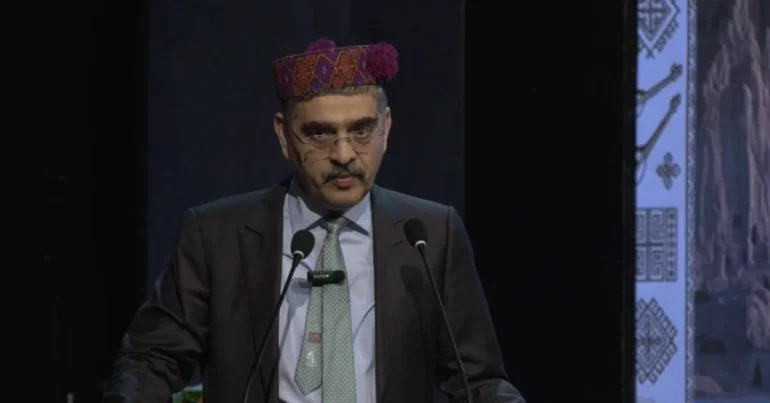

KABUL, AFGHANISTAN – Anwaar-ul-Haq Kakar, Pakistan’s former prime minister, has compared the policies of Abdul Rahman Khan, the former king of Afghanistan, toward the Hazaras to the policies of Adolf Hitler, the Nazi leader of Germany, against the Jews.
According to Urdu International, Mr. Kakar made the remarks during a “Hazara Culture Day” ceremony in Islamabad, saying that Abdul Rahman’s era was Afghanistan’s Nazi experience and that he “did exactly what Hitler did to the Jews.”
Speaking at the event, the former Pakistani prime minister described Hazara culture as rich and referred to the community as “the heirs of Sanskrit, the heirs of Turkic peoples, the heirs of the Upanishads and the Vedas, the heirs of the Quran, the heirs of the English language, and the heirs of the Persian language.”
Abdul Rahman Khan, the former king of Afghanistan, is accused of carrying out the “massacre” and “genocide” of Hazaras between 1891 and 1893.
According to historical documents, on September 25, 1891, he ordered the massacre and forced displacement of Hazaras, which resulted in the killing of more than half of the Hazara population.
In recent years, Hazara activists have commemorated September 25 as a day of remembrance for the massacre of Hazaras by Abdul Rahman Khan and have called for the official recognition of the “Hazara genocide” in Afghanistan.
The remarks come amid continuing efforts by Hazara activists, scholars, and rights advocates to preserve historical memory and push for broader international recognition of past atrocities against the community, arguing that acknowledgment is essential for justice, reconciliation, and preventing the repetition of such violence in the future.
Hazaras, a distinct ethnic group and predominantly Shia, remain among Afghanistan’s most vulnerable communities. They have endured decades of targeted attacks, massacres, discrimination, and marginalization, with little protection or access to justice. Since the Taliban’s return to power in 2021, the situation has worsened, with rising attacks, systematic exclusion from education, employment, and public services, and limited security.
A report by Etilaatroz documented at least 61 targeted attacks on Shia Hazaras over 39 months of Taliban rule, leaving 473 dead and 681 injured, an average of nearly one death every three days and one injury every two days.
In 2022, Richard Bennett, the UN Special Rapporteur for Human Rights in Afghanistan, called for investigations into the attacks on Hazara and Sufi communities. He said that these attacks are “becoming increasingly systematic in nature and reflect elements of an organizational policy,” and that they may therefore constitute “crimes against humanity.”
In addition, The Afghanistan Human Rights and Democracy Organization (AHRDO), in its report titled “International Crimes of ISKP in Afghanistan 2016–2024,” stated that attacks carried out by the Islamic State of Khorasan Province (ISKP) against Hazara and Shia communities in Afghanistan may amount to “genocide, war crimes, and crimes against humanity” under international law.
The report documents a sustained pattern of violence between 2015 and 2024, including dozens of suicide attacks and bombings targeting civilian populations, with a particularly high number of casualties among students and worshippers. It also highlights the use of dehumanizing language in ISKP propaganda against Shia Muslims.
Hazara activists have long urged the United Nations and the international community to formally recognize the violence against Hazaras as “genocide” and to take meaningful steps to prevent further atrocities.

