

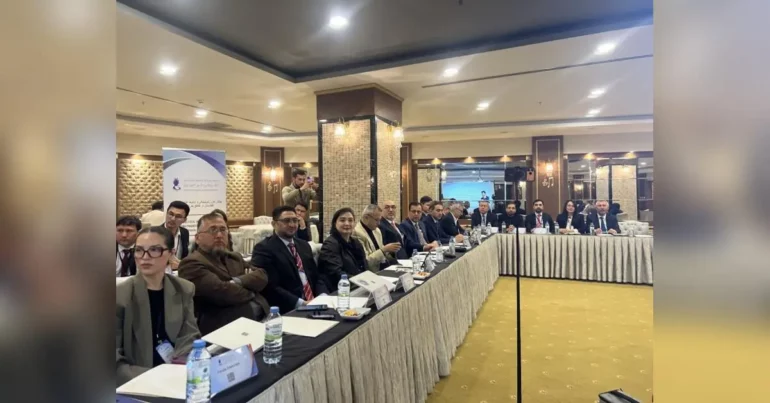

KABUL, AFGHANISTAN – The “Lajivard Yolu Research and Policy Center” has announced the start of a two-day conference on regional developments and the situation in Afghanistan, with the participation of a number of political figures opposed to the Taliban, civil activists, and experts in Ankara, Turkey.
The center stated that the conference, titled “Political Transformation and Regional Order; Afghanistan in a Changing Geopolitical Landscape,” began yesterday (Friday, April 24) and will continue today.
The Lajivard Yolu Center said that this conference “aims to create a platform for critical political dialogue, focusing on Afghanistan’s evolving position within regional and international political structures, and exploring pathways toward constructive engagement and political stabilization.”
Rahila Dostum, daughter of Abdul Rashid Dostum, the leader of the National Islamic Movement of Afghanistan, was among the speakers on the first day of the conference.
In her speech, she stated that one of Afghanistan’s fundamental problems has been the monopoly of power, a centralized system of governance, injustice, and the marginalization of many ethnic groups.
Rahila Dostum said that this situation has led to “various ethnic groups being deprived of genuine participation in political decision-making, resulting in the spread of feelings of injustice and distrust within society.”
She also noted that in the past five years, during which the Taliban have been in control of Afghanistan, ethnic discrimination and biases have intensified in a concerning manner.
Participants in the conference not only discussed the situation in Afghanistan but also examined the impacts of regional developments on the country’s condition.
The “Lajivard Yolu Research and Policy Center” has previously hosted conferences on Afghanistan and has sought to analyze and assess the country’s current situation with the participation of experts, academics, and political elites.
Such gatherings highlight the growing need for inclusive dialogue and collaborative approaches to address Afghanistan’s complex challenges, especially in light of shifting regional dynamics and the urgent need for sustainable political solutions.
Recent security developments in Afghanistan remain deeply interconnected with political instability and regional dynamics, as highlighted in discussions like the Ankara conference organized by the Lajvard Yoli Research and Policy Center. Since the Taliban’s return to power in 2021, the country has faced persistent threats from militant groups such as ISIS-K, alongside internal challenges stemming from centralized governance and exclusionary political structures.
Tensions along the Afghanistan–Pakistan border have further complicated the situation, with recurring clashes, cross-border shelling, and mutual accusations of harboring militant groups. Pakistan has expressed concerns over the presence of Tehrik-i-Taliban Pakistan (TTP) fighters inside Afghanistan, while Afghan authorities have criticized Pakistan’s military actions in border provinces. These dynamics not only strain bilateral relations but also contribute to broader regional insecurity, affecting trade routes, refugee flows, and diplomatic engagement across South and Central Asia.
At the same time, the condition of ethnic and religious minorities under Taliban rule has become an increasingly urgent concern, reinforcing points raised by speakers such as Rahila Dostum during the Ankara conference. Reports from various human rights organizations indicate that communities including Hazaras, Tajiks, and other minority groups continue to face systemic discrimination, limited political representation, and threats to their safety.
According to a report published by Human Rights Watch, in July 2025, the Taliban forcibly displaced 25 families, approximately 200 people including women, children, and the elderly, from Rashk village in Bamyan, a Shia Hazara-majority province, following a land dispute ruling in favor of nomadic Pashtun Kuchis. In the same province, the Taliban banned Shia religious books and prohibited Shia religious gatherings.
Citing a United Nations report, HRW noted that in Badakhshan province, 50 Ismaili Shias were physically abused and threatened with death, and were forced to convert to the Sunni Hanafi sect.
In June 2025, after protests by Uzbeks over a local dispute with Pashtun villagers in Faryab province, the Taliban briefly detained a large number of Uzbeks.
Since returning to power in 2021, the Taliban have faced widespread accusations of discrimination against non-Pashtun ethnic groups and religious minorities, alongside restrictions on civil liberties, media operations, and public dissent.
The lack of inclusive governance and meaningful participation has deepened mistrust within Afghan society, echoing concerns about power monopolization and injustice. These internal fractures, combined with external tensions involving Pakistan and ongoing security threats, create a fragile environment that directly impacts regional stability.
As emphasized in the conference, without inclusive political reforms and constructive regional cooperation, Afghanistan’s challenges risk escalating into wider security concerns affecting neighboring countries and the broader geopolitical landscape.

