

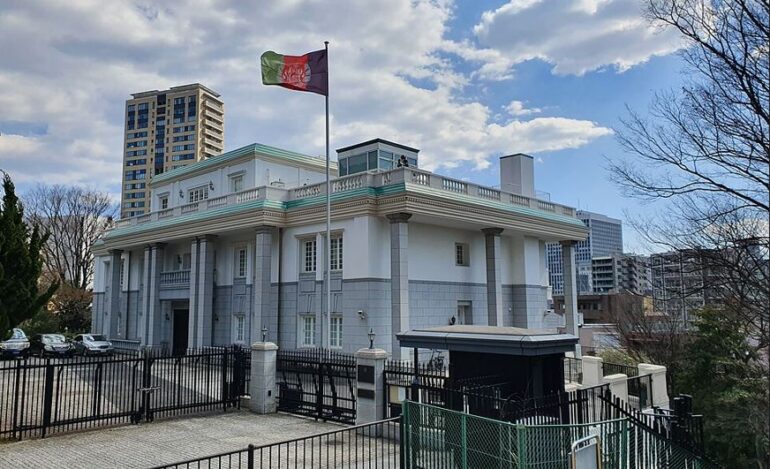

KABUL, AFGHANISTAN – The Afghanistan Embassy in Tokyo formally suspended operations on Saturday, January 31, outgoing ambassador Shaida Mohammad Abdali said, marking the end of the mission’s activities under diplomats appointed by Afghanistan’s former government.
In a post on X, Abdali said he was leaving Tokyo “with a heavy heart” and expressed pride in keeping Afghanistan’s national flag flying over the embassy until the final moment. He added that he hoped the tricolor flag “will continue to fly proudly until the arrival of the next legitimate Afghan representative and beyond.”
The embassy had continued functioning under appointees of the pre-2021 Afghan republic since the Taliban’s return to power. It announced the suspension in late December 2025 after consultations with the Japanese government. A statement from the embassy confirmed Japan would uphold the inviolability of the premises, property, and archives in accordance with the Vienna Convention on Diplomatic Relations.
Japan maintains its embassy in Kabul and continues to deliver humanitarian assistance to Afghanistan, but has neither recognized the Taliban administration nor transferred control of Afghanistan’s diplomatic missions to the group.
In recent years, many of Afghanistan’s embassies and consulates around the world have closed or significantly scaled back their operations amid funding shortfalls, legal uncertainty, and political pressure. In some host countries, diplomatic staff have been replaced by representatives nominated by the Taliban, while many other missions have suspended activities altogether, leaving Afghan citizens abroad with limited access to diplomatic and consular services.
A day earlier, the Afghanistan Embassy in Australia announced it would cease operations after June 30, 2026, following consultations with the Australian government. In a joint statement, the embassy and Australia’s Department of Foreign Affairs and Trade said the mission would not be handed over to the Taliban or accept diplomats appointed by the group, citing the Taliban’s systematic human rights violations, particularly against women and girls. Australia will continue to protect the embassy premises and archives under international law following the closure.

