

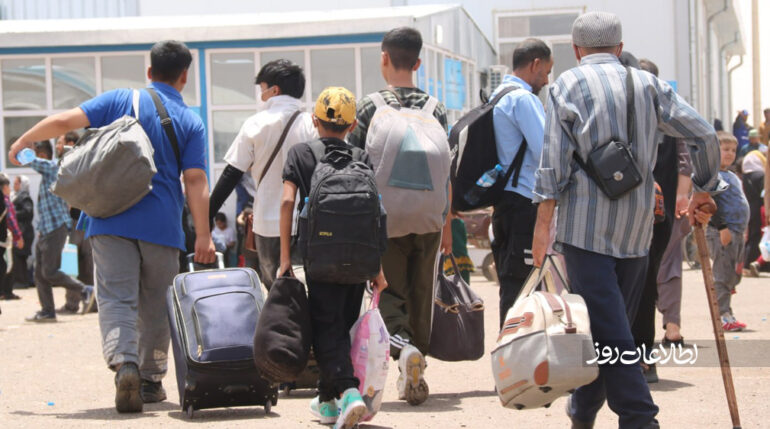

KABUL, AFGHANISTAN – Amnesty International has called on countries to immediately stop the forced return of Afghan refugees and asylum seekers to Afghanistan, citing a deepening humanitarian crisis and widespread human rights abuses under Taliban rule.
In a statement on Tuesday, the international rights group said new UN figures show that more than 2.6 million people have been unlawfully returned to Afghanistan so far this year from Iran and Pakistan alone. Amnesty said about 60% of those returned are women and children, while thousands of other Afghans have also been deported from Turkey and Tajikistan.
Amnesty said the mass returns are taking place as the Taliban continue to impose sweeping restrictions on basic rights, particularly for women and girls, and as Afghanistan struggles with overlapping humanitarian emergencies. The group added that the recent series of natural disasters has further worsened already dire living conditions across the country.
“Afghanistan’s deepening humanitarian crisis increases the real risk of serious harm for returnees and underscores states’ binding non-refoulement obligations under customary international law,” Amnesty said, referring to the principle that prohibits sending people back to places where they face a real risk of grave human rights violations.
The group said several European countries have also increased efforts to forcibly return Afghan migrants. It cited reports indicating that Germany, Austria, and the European Union are holding discussions with Taliban authorities aimed at facilitating deportations.
“Despite the Taliban’s well documented repression of human rights, many states, including Iran, Pakistan, Turkey, Tajikistan, Germany and Austria, are clamouring to deport Afghans to a country where violations, particularly against women, girls and dissenting voices, are widespread and systematic,” said Smriti Singh, Amnesty International’s Regional Director for South Asia. She said this is happening at a time when more than 22 million people in Afghanistan, nearly half the population, need humanitarian assistance.
Amnesty said it conducted 11 remote interviews between July and November 2025 with Afghans who had been deported or who were at risk of imminent expulsion. Those interviewed included people who previously worked with the former Afghan government, security forces or international organizations. They described facing arbitrary arrest, torture and threats after returning to Afghanistan.
Women interviewed by Amnesty said they were denied access to education, employment and freedom of movement, while former officials and security personnel said they continued to face persecution and intimidation.
The group also cited findings by the UN Assistance Mission in Afghanistan (UNAMA), which documented 21 cases of arbitrary arrest and torture and 14 killings of former security personnel between July and September 2025. Amnesty said many returnees struggle with debt, poverty, unemployment and lack access to basic services, further worsening the humanitarian crisis.
“All states must immediately stop forced returns and uphold their non-refoulement obligations under international law,” Singh said. She urged governments to expand and fast-track resettlement pathways and to recognize Afghan human rights defenders, women and girls, former officials, journalists and others at heightened risk as refugees in need of protection.

