

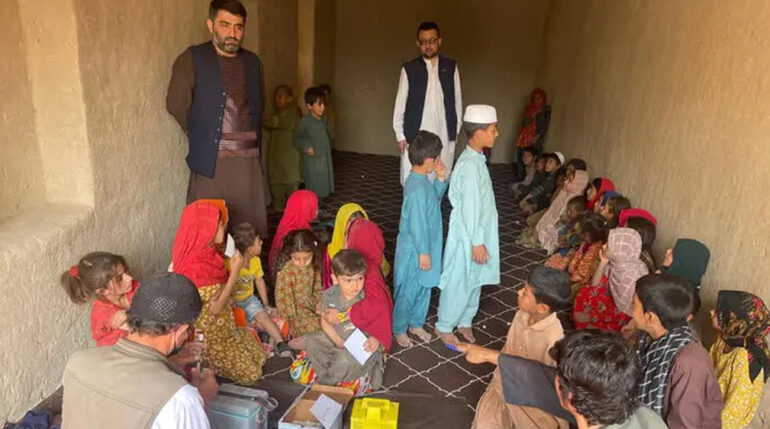

KABUL, AFGHANISTAN – More than 8 million children in Afghanistan have been vaccinated in the second phase of a nationwide measles campaign, the UN said, as the country faces a surge in cases of the deadly disease.
In a statement on Tuesday, the World Health Organization (WHO) said that, in partnership with the UN Children’s Fund (UNICEF), Gavi, the Vaccine Alliance, and Afghanistan’s National Expanded Programme on Immunization (NEPI), 8,355,000 children aged six months to 10 years were vaccinated against measles in this round across 17 provinces, reaching 91.7% of the 9 million children target.
In addition, nearly four million children across five southern and southeastern provinces were given one dose of the bivalent oral polio vaccine, the statement said.
The first phase of the nationwide measles campaign was completed in October, reaching 8.3 million children in provinces with colder climates. With the conclusion of the second phase, over 16.6 million children across Afghanistan are now protected against measles.
“The conclusion of this second phase marks another important step in protecting Afghanistan’s children from a disease that should never cost a young life,” UNICEF Representative in Afghanistan Dr. Tajudeen Oyewale said. “Reaching millions of children in every type of community is only possible because families, health workers and partners came together with one purpose: to keep children safe.”
Measles is one of the most contagious and deadly diseases for children in Afghanistan, where high rates of malnutrition, poverty, and limited healthcare access leave millions at risk. Official data show more than 9,300 cases were reported in 2024, with an additional 8,500 cases reported by August 2025. UN agencies have repeatedly warned of surges in measles outbreaks, particularly during the cold season, urging families to vaccinate their children promptly.
The vaccination drive comes amid one of Afghanistan’s most severe healthcare crises in decades. Since the Taliban’s return to power in August 2021, international funding cuts and restrictions have severely hampered healthcare delivery. According to the UN, more than 23 million Afghans—over half the population—require humanitarian assistance, including around 12 million children. Over 12 million people face acute food insecurity, while malnutrition rates remain among the highest globally.

