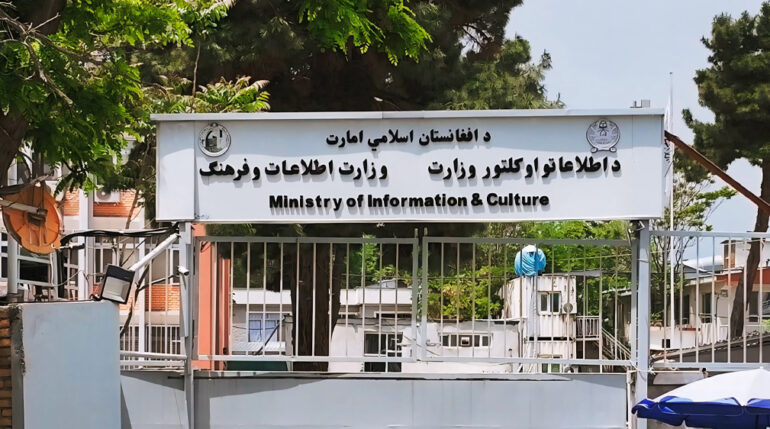

KABUL – The Taliban’s Ministry of Information and Culture has announced plans to establish what it calls “jihad museums” and “jihad archives” to preserve the group’s war-related artifacts and record what it describes as the history of jihad.
Khairullah Khairkhwa, the Taliban’s Minister of Information and Culture, discussed the plan with the group’s governor in Jowzjan, Gul Haidar Shafaq, during a recent visit to the province.
In a statement on Monday, Khairkhwa said: “To preserve jihadi relics, in addition to establishing jihadi museums, a jihadi archive will also be built, and the history of jihad and past struggles will be recorded.”
It is not clear what items the Taliban intend to showcase, though in the past they have displayed motorbikes and barrel-shaped improvised explosive devices (IEDs)—weapons that were central to the group’s insurgency against Afghan security forces and international troops for two decades.
The project follows the Taliban’s creation of the so-called “Victory Museum” in Mazar-i-Sharif, which features suicide bomb paraphernalia such as IED barrels, motorcycles, and rocket-propelled grenades, alongside antique Qurans, all presented as symbols of sacrifice by “martyrs.”
Residents and mental health experts warn that such displays glorify violence and risk traumatizing young visitors.
Suicide bombing, institutionalized under Taliban rule, was carried out by organized “isteshhadi” (martyrdom) brigades.
Since their return to power in 2021, the group has staged high-profile ceremonies honoring suicide bombers, with Interior Minister Sirajuddin Haqqani reportedly offering land and cash rewards to their families, moves widely condemned by rights groups.
The Taliban’s effort to enshrine their insurgency in museum form starkly contrasts Afghanistan’s broader cultural heritage. During their first rule in the 1990s, the group destroyed invaluable artifacts, most notoriously the Buddhas of Bamiyan in 2001, and looted museums, libraries, and manuscripts, actions scholars describe as cultural genocide.