

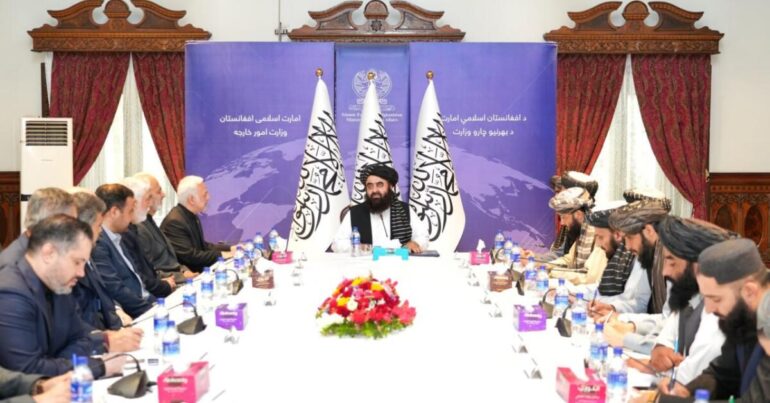

KABUL, AFGHANISTAN – The Taliban’s acting Foreign Minister, Amir Khan Muttaqi, met with Vahid Jalalzadeh, Iran’s Deputy Foreign Minister for Consular Affairs, in Kabul on Monday to discuss bilateral relations, consular services, and border cooperation.
According to a statement issued by the Taliban’s Ministry of Foreign Affairs, the two sides focused on improving consular services for citizens and strengthening coordination between the two neighboring countries.
During the meeting, Muttaqi said consular services should be made easier, faster, and aligned with internationally accepted standards. He also described relations between the Taliban and Iran as continuing to expand.
The Taliban’s Foreign Ministry said Jalalzadeh emphasized the importance of consular coordination between the two countries and expressed hope that ongoing talks would lead to better organization and expanded consular facilities for the citizens of both Afghanistan and Iran.
Jalalzadeh arrived in Kabul earlier on Monday and said the purpose of his visit was to participate in the “Fifth Joint Consular Meeting” between Iran and the Taliban.
Iran is home to one of the world’s largest Afghan migrant and refugee populations, including both documented and undocumented individuals. Large numbers have fled Afghanistan over decades of conflict, economic hardship, and political instability, with many arriving after the Taliban seized power in August 2021.
Since the Taliban returned to power in Afghanistan in August 2021, Iran has maintained broad political and economic engagement with the group. Tehran has handed control of the Afghan embassy and consulates in Iran to Taliban-appointed representatives, while Iran’s embassy in Kabul and its consulates in several major Afghan cities have remained operational.
Despite ongoing engagement, Iran has not formally recognized the Taliban government. However, Iranian officials have previously said that discussions over possible recognition have been underway, and some observers believe Tehran could formally recognize the Taliban administration in the future. Relations between Iran and the Taliban have remained complex, marked by cooperation on trade, migration, and border security alongside periodic tensions over issues such as water rights and the treatment of Afghan migrants.
However, consular services, including visa issuance for Afghan citizens, have remained limited. The regular process for obtaining Iranian visas is currently suspended for most Afghans, with visas generally issued only to individuals holding invitations from Iranian employers, as well as political, religious, and cultural figures with close ties to Iran and Taliban officials.
The discussions come as millions of Afghans continue to rely on cross-border travel for work, trade, education, and family connections. Improving consular cooperation could help address administrative challenges faced by Afghan nationals seeking legal travel and documentation, although no specific measures or timeline for expanding visa services were announced following the meeting.

