

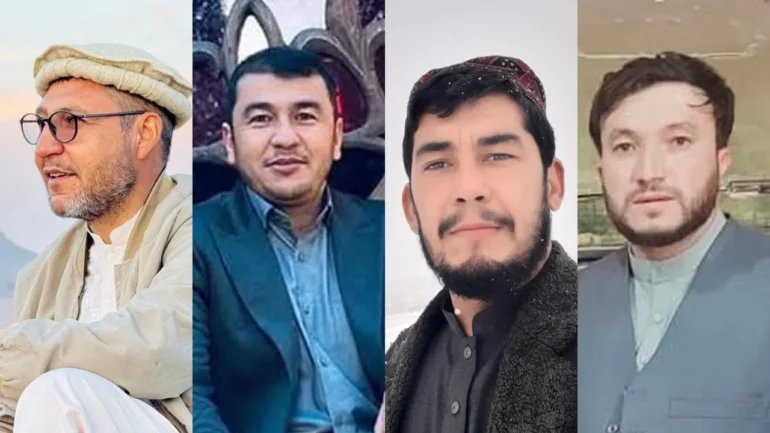

KABUL, AFGHANISTAN – Local sources in Afghanistan’s western Ghor province say Taliban forces have detained eight former government officials and members of the former Afghan security forces in Firozkoh city and Murghab district.
According to the sources, the arrests were carried out on Tuesday by members of a Taliban brigade stationed in Ghor. The whereabouts and condition of the detainees remain unknown.
The detained individuals have been identified as Gul Ahmad Rostami, former head of the Department of Martyrs and Disabled Affairs; Sayed Rahman Rahmani, former director of District 3 of the Firozkoh Municipality; Musa Fadaei, former head of Border and Tribal Affairs; Zia-ul-Haq Joya, former revenue director at the provincial Department of Agriculture; Fazl Ahmad, a former employee of the National Directorate of Security (NDS); Naqibullah, a former police officer in Ghor; and Mohammad Saleh and Mohammad Haidar, both former soldiers under the previous Afghan government.
Sources said Musa Fadaei, who currently works at the Ghor branch of Bank-e-Milli Afghanistan, and Zia-ul-Haq Joya, who is currently employed by the Taliban’s Department of Agriculture in Ghor, were arrested from their workplaces in Firozkoh at around 2:00 p.m. on Tuesday.
According to the sources, Mohammad Haidar had traveled to Murghab district to visit a relative when he was detained. Mohammad Saleh and Fazl Ahmad were arrested from their villages in Murghab at around 8:00 p.m., while Gul Ahmad Rostami, Sayed Rahman Rahmani, and Naqibullah were detained in the district’s main market.
Sources said the families of the detainees sought information from the Taliban governor’s office, the provincial intelligence department, and the police command in Ghor. However, they were reportedly told that the Taliban brigade had carried out the arrests independently and without coordination with those institutions, and that local authorities had no authority to intervene in the brigade’s decisions.
The families later approached the Taliban brigade directly, but its officials reportedly refused to meet with them or provide any information about the detainees.
The reason for the arrests remains unclear, and Taliban authorities in Ghor have not commented on the incident.
The arrests come amid increasing reports of arbitrary detentions by the Taliban across various provinces, particularly targeting former government employees, civil society members, and civilians in regions with a history of resistance or ethnic tensions.
A report published earlier by the UK-based rights group Rawadari documented a significant deterioration in Afghanistan’s human rights situation in 2025.
According to the report, at least 617 people were killed and 537 others were injured across the country, representing an increase of more than 50% compared to the previous year. The findings highlighted at least 611 civilians affected in targeted, suspicious, or extrajudicial incidents, with victims largely including former government employees, individuals accused of links to opposition groups, protesters, tribal elders, and local community figures.
The report also recorded a sharp rise in arbitrary detentions and enforced disappearances, with at least 2,559 people unlawfully detained in 2025—more than double the figure from 2024. Among those detained were former government employees, civil society members, human rights defenders, including women, and individuals accused of ties to opposition groups.
These findings reflect broader concerns raised by human rights organizations about increasing violence, arbitrary detention, and lack of accountability in Afghanistan under Taliban rule.
Human rights organizations, including Amnesty International and Human Rights Watch, have repeatedly raised alarms over the lack of due process and the growing number of enforced disappearances under Taliban rule since their return to power in August 2021.

