

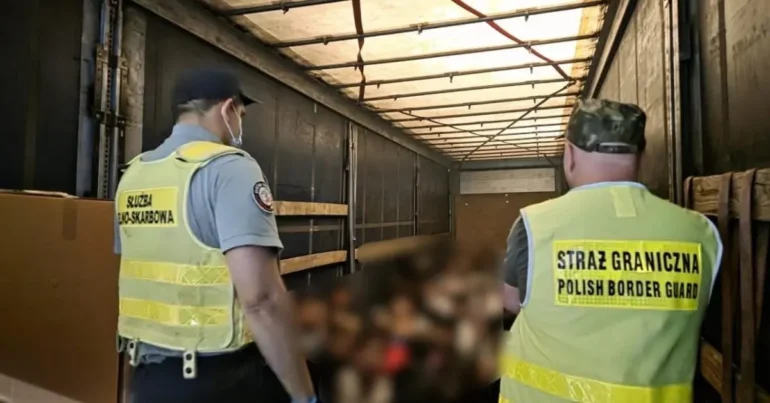

KABUL, AFGHANISTAN – Polish police have announced the detention of 54 migrants, including 15 Afghan nationals, while attempting to enter the country illegally.
In a statement published on X yesterday on (Friday, July 3), the Polish police said the migrants had attempted to enter Poland through the Lithuanian border.
According to the statement, the group consisted of 30 Pakistanis, 15 Afghans, and 9 Bangladeshis.
Polish police also released images purportedly showing the migrants at the time of their detention, depicting dozens of people sitting inside a metal container.
The migrants are expected to be handed over to the Lithuanian authorities after administrative procedures are completed.
Despite the tightening of immigration laws and the reduction of resettlement and admission programs, the movement of migrants from Asian and African countries toward Europe continues.
Among them, many young Afghans—facing widespread poverty, unemployment, and deep uncertainty about their future following the collapse of the former Afghan government and the Taliban’s return to power—view reaching Europe as an opportunity to support their families and build a better future. In pursuit of that goal, many undertake dangerous and irregular migration routes.
Afghan migration to Europe is not a new phenomenon, but it has intensified during periods of conflict and political upheaval, particularly after the Taliban first came to power in the 1990s, following the 2001 conflict, and most significantly after the Taliban regained control of Afghanistan in August 2021.
According to the International Organization for Migration (IOM), around eight million Afghans have left the country since 2020, with about one million reaching European countries, most via irregular migration channels. The IOM also reports that at least 5,046 Afghan migrants have died since 2014, including many after the Taliban’s return to power.
Since then, thousands of Afghans have attempted to leave the country through legal and irregular means, driven by insecurity, economic hardship, restrictions on education and employment—especially affecting women and young people—and concerns about their future.
Many undertake long and dangerous journeys through neighboring countries and along smuggling routes in hopes of reaching European countries, despite increasingly strict border controls and immigration policies across the continent. Their journeys often expose them to exploitation, detention, violence, and life-threatening conditions before they are able to seek asylum or other forms of protection.

