

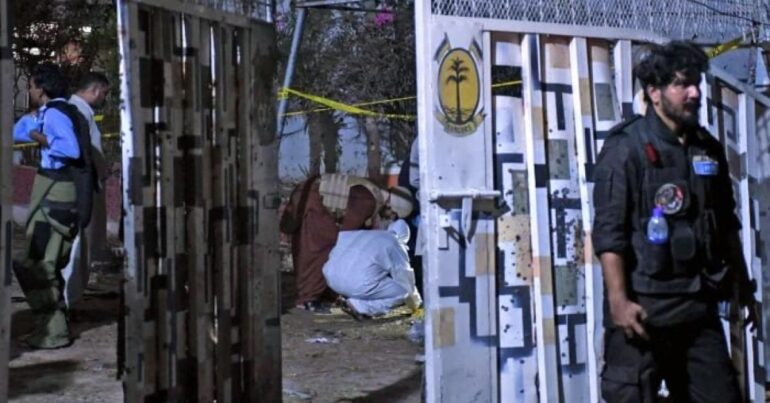

KABUL, AFGHANISTAN – Pakistani police said on Tuesday they had arrested the alleged mastermind behind a deadly attack on a Rangers camp in Karachi last month and claimed the assault was planned, directed, and supported from Afghanistan.
The attack targeted the local headquarters of the Pakistan Rangers (Sindh) in Karachi’s Gulistan-i-Jauhar area on June 27. Three security personnel were killed and four others wounded, according to the military’s media wing, Inter-Services Public Relations (ISPR).
As reported by Pakistani media, Sindh Home Minister Ziaul Hassan Lanjar and senior Karachi police officer Irfan Bahadur said at a joint press conference that the attack was carried out by militants affiliated with Jamaat-ul-Ahrar, a faction of Tehrik-i-Taliban Pakistan (TTP).
The officials said security forces killed three attackers during the operation and arrested a fourth, whom they identified as an Afghan national.
Pakistani authorities identified the alleged mastermind as Qari Basheer, also known as Qari Habib, and said he was arrested in a Rangers operation following the attack. They added that several alleged facilitators and weapons smugglers linked to the assault had also been detained.
Lanjar said the attackers were directed by handlers operating from Afghanistan and were instructed to inflict maximum damage, take hostages, and undermine security in Karachi.
Bahadur said investigators had determined that the operation involved four stages: planning and training in Afghanistan, movement of four militants to Karachi, logistical support from a facilitator network in the city, and the supply of weapons, ammunition, and suicide vests.
The officials identified the suicide bomber as Janaan, a resident of Afghanistan’s Farah province. They named the other slain attackers as Bilal, also known as Hadi, who they said later moved to Kandahar after being born in Pakistan’s Bajaur district, and Umer Farooq, a resident of Afghanistan’s Kunar province.
The surviving attacker, arrested while wounded, was identified as Usman Sher Mohammad from Afghanistan’s Nangarhar province.
Pakistani officials said evidence gathered during the investigation indicated that planning, coordination and operational guidance for the attack originated from Afghanistan.
The Taliban authorities in Afghanistan have not responded to the latest allegations. They have previously rejected similar accusations, saying Pakistan should address its own security challenges rather than blame Afghanistan.
The attack came amid rising tensions between Islamabad and the Taliban over cross-border militancy. Pakistan accuses the Afghan Taliban of providing sanctuary to TTP fighters and allowing them to use Afghan territory to plan attacks in Pakistan. The Taliban deny the allegations.
On June 28, a day after the Karachi attack, Pakistan’s military conducted airstrikes in Afghanistan’s eastern provinces of Paktia, Paktika, and Kunar, saying it targeted TTP and Jamaat-ul-Ahrar positions. The UN mission in Afghanistan (UNAMA) confirmed that the strikes killed at least 28 civilians and wounded 49 others in Paktia, Paktika, and Kunar provinces.
Militant violence has increased in Pakistan in recent years, particularly in the northwestern Khyber Pakhtunkhwa and southwestern Balochistan provinces, where TTP militants and Baloch separatist groups have intensified attacks on security forces and government installations.
Tensions between the two former allies have risen sharply since late 2025, involving border clashes, Pakistani airstrikes inside Afghanistan, and retaliatory actions that have caused hundreds of casualties in Afghanistan, including civilians.

