


KABUL, AFGHANISTAN – Pakistan’s Ministry of Foreign Affairs has accused India of supporting terrorist groups operating from Afghanistan, responding to New Delhi’s condemnation of Pakistan’s recent airstrikes inside Afghanistan.
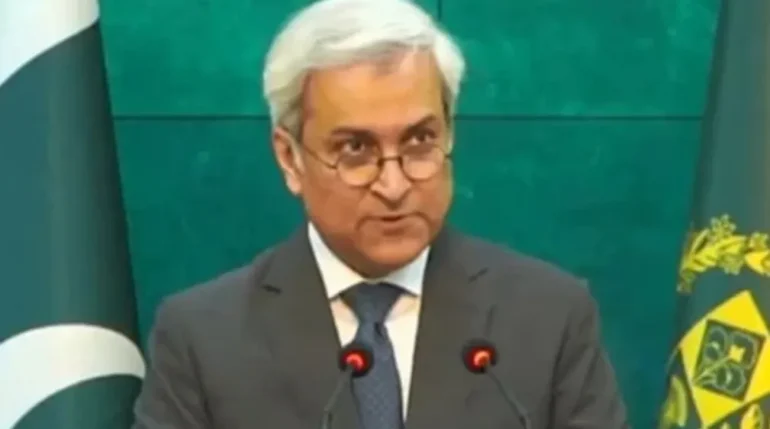
Tahir Andrabi, spokesperson for Pakistan’s Foreign Ministry, issued a statement today (Wednesday, July 1) in response to the Indian Foreign Ministry’s remarks.
He said the statement was issued by a country that undermines the sovereignty and territorial integrity of its neighboring states, suppresses the right to self-determination of Kashmiris in occupied Jammu and Kashmir, and actively supports and financially backs terrorist groups operating from Afghan soil against Pakistan.
The Pakistani Foreign Ministry spokesperson again described the airstrikes on Afghanistan as legitimate, targeted, and proportionate actions and aimed at terrorist infrastructure in Afghanistan, emphasizing that the country will continue to take all necessary measures to ensure the safety and security of its citizens in accordance with international law.
Following Pakistan’s airstrikes in Paktia, Paktika, and Kunar provinces in eastern Afghanistan, India’s Foreign Ministry issued a statement strongly condemning the attacks and calling them a blatant violation of Afghanistan’s sovereignty.
The Indian Foreign Ministry added that this action reflects Pakistan’s continued pattern of reckless behavior and a futile attempt to cover up its internal failures through violent and desperate actions beyond its borders.
The latest exchange of statements follows Pakistani airstrikes conducted on Sunday night in Afghanistan’s eastern provinces of Paktia, Paktika, and Kunar. Islamabad said those operations targeted hideouts belonging to the Tehrik-i-Taliban Pakistan (TTP) and the allied Jamaat-ul-Ahrar group, resulting in the deaths of 25 militants. The country has also repeatedly alleged that these groups are supported by India.
The Taliban, however, stated that civilian homes were targeted in the attacks, resulting in 36 deaths and 163 injuries.
The United Nations Assistance Mission in Afghanistan (UNAMA) confirmed the deaths of 28 civilians and injuries to 49 others in these strikes.
Meanwhile, senior Taliban officials have sharply criticized Pakistan’s military action.
Speaking at a gathering with journalists in Samangan province (northern Afghanistan) on Wednesday, Taliban Minister of Information and Culture Shir Ahmad Haqqani, said Pakistan was targeting civilians in Afghanistan under various pretexts, but such attacks did not represent a victory because “we have become accustomed to bombs.”
He added that the Taliban had endured years of bombardment, suffered many casualties, and had never surrendered despite facing opponents with far greater military capabilities.
The Taliban minister further said the group would not surrender to Pakistan and argued that Islamabad lacked the capability, resources, and internal unity to force the Taliban into submission.
He also claimed that if Pakistan continued what he described as its “oppressive actions” against the Taliban, divisions and internal conflict within Pakistan would deepen and could even lead to the country’s disintegration.
Relations between Pakistan and the Taliban have deteriorated markedly in recent months over security concerns. Islamabad accuses Kabul of allowing TTP militants to use Afghan territory as a base for operations against Pakistan, a charge the Taliban deny.
The exchange of accusations highlights the increasingly complex regional dynamics surrounding Afghanistan. Pakistan has repeatedly accused militant groups such as Tehrik-i-Taliban Pakistan (TTP) of operating from Afghan territory and has justified cross-border strikes as necessary for its national security.
The Taliban, however, reject these claims and have condemned the attacks as violations of Afghanistan’s sovereignty that primarily harm civilians. India, which has long had strained relations with Pakistan, has strongly criticized the airstrikes and reaffirmed its support for Afghanistan’s sovereignty and territorial integrity.
The differing reactions reflect broader geopolitical rivalries in South Asia, where Afghanistan continues to be affected not only by its internal humanitarian and security challenges but also by competing regional security interests and diplomatic tensions.

