

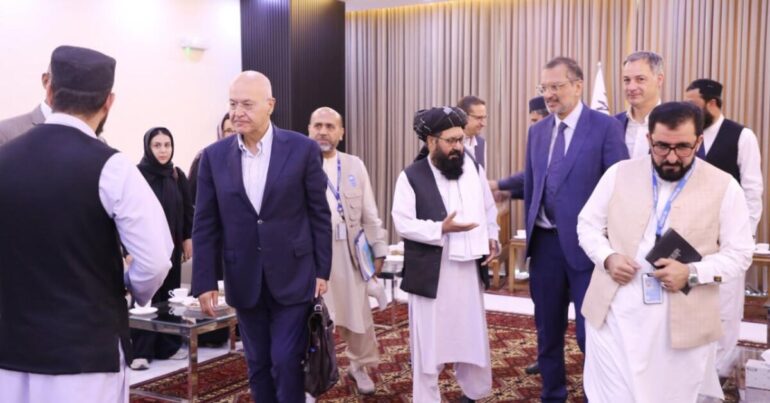

KABUL, AFGHANISTAN – Barham Salih, the United Nations High Commissioner for Refugees, and Alexander De Croo, Administrator of the United Nations Development Programme (UNDP), arrived in Kabul on a three-day visit.
The two senior United Nations officials arrived in Kabul today (Sunday, July 5) and were received by officials from the Taliban’s Ministry of Refugees and Repatriation.
A UNAMA spokesperson, in a statement sent to the media, said that the visit provides an opportunity to directly listen to the people of Afghanistan and gain a better understanding of how the United Nations supports existing solutions.
He added that the visit will focus on the pressures faced by returnees, internally displaced persons, and the communities hosting them.
According to the UNAMA spokesperson, at a time when international resources and attention are declining, the delegation will highlight the importance of sustained and coordinated support for the people of Afghanistan, particularly women, girls, returnees, and host communities.
The senior UN officials are visiting Afghanistan at a time when Taliban restrictions have intensified and the humanitarian situation has worsened.
Afghanistan has experienced a sharp increase in returns since late 2023 as Pakistan and Iran have intensified enforcement against undocumented Afghan migrants. UN figures indicate that more than 5.4 million Afghans have returned or been deported from the two countries combined since October 2023, with around 2.9 million in 2025 alone.
The rise in returns comes as Afghanistan faces a worsening humanitarian situation. UN estimates nearly 22 million people, close to half the population, require humanitarian assistance this year, while around 4 million children are suffering from acute malnutrition.
The United Nations has requested $1.71 billion to assist these people, but so far only 16 percent of the required funding has been secured.
In addition, clashes between Pakistani security forces and Taliban fighters, which reportedly began in late February 2025 and have continued intermittently for more than two months, have further worsened an already fragile humanitarian situation in Afghanistan.
The escalation in cross-border violence, along with the suspension of trade, transit, and land travel between the two countries for several months, has disrupted livelihoods, reduced access to essential goods, and increased economic pressure on ordinary people. As a result, humanitarian needs inside Afghanistan have grown further, deepening the reliance of vulnerable communities on international aid at a time when funding for relief operations remains insufficient.

