

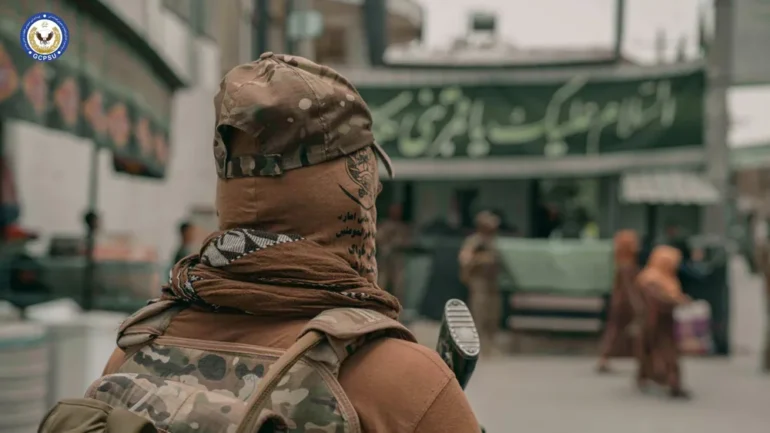

KABUL, AFGHANISTAN – Local sources in Qarabagh, Kabul say that Taliban “Promotion of Virtue and Prevention of Vice” officials disrupted Ashura mourning ceremonies for Shiites on the day of Ashura and, during the interruption of the mourning gathering at the “Khatam al-Anbiya Mosque in Qala-e-Shahi,” stated that “eating Shiite offerings (nazr) is forbidden.”
A source told the newspaper KabulNow today (Sunday, 28 June) in a message that Taliban officials stormed the mosque during the Ashura ceremony, expelled the mourners from the mosque, and locked the mosque gate.
According to the source, the Taliban “Promotion of Virtue and Prevention of Vice” officials even prevented local residents from eating Shiite offerings and, while insulting the Shiite faith, said that Shiites are “polytheists” and that eating their offerings is “haram.”
According to the source’s information, after this incident, Shiites went to the Taliban district governor in Qarabagh, Kabul to address the issue, but he also paid no attention to it.
Sources say that in Qarabagh district of Kabul, only residents of one village are Shiite, and every year they hold Ashura mourning ceremonies with the participation of Sunni followers, and a large number of Sunnis also attended this year’s ceremony.
Since taking control, the Taliban have progressively tightened rules on Shia practices. Public sermons in major cities such as Kabul, Herat, and Mazar-e-Sharif have been curtailed, while convoys and public recitations of elegies have been barred. In 2023, Taliban forces opened fire on Ashura mourners in Ghazni province, killing four people and wounding nearly 33 others.
The incident comes months after the Afghan human rights organization Rawadari documented what it described as widespread and systematic discrimination against Afghanistan’s ethnic and religious minorities under Taliban rule.
In its Afghanistan Human Rights Situation Report 2025, released three months ago, the organization said Hazara Shiites and the Ismaili community were among the groups most affected by restrictions on religious freedom and unequal treatment. According to the report, Taliban authorities imposed limitations on Shiite religious practices, including restrictions on Muharram and Ashura ceremonies, the removal of mourning flags, the blocking of religious processions, and the detention of Shiite religious scholars in some provinces.
The report also documented discrimination in public employment, humanitarian assistance, and development projects, concluding that members of minority communities, particularly Hazara Shiites, faced disproportionate barriers to exercising their religious rights and accessing public resources.
In addition, a 2025 report by the United States Commission on International Religious Freedom said the Taliban had effectively “eradicated” religious freedom in Afghanistan by enforcing a single interpretation of Islam and targeting religious minorities. The commission urged the U.S. State Department to designate Afghanistan as a “country of particular concern” over systematic violations of religious freedom.
Ashura is an important religious observance in the Islamic month of Muharram, particularly for Shiite Muslims, who commemorate the martyrdom of Imam Hussain, the grandson of the Prophet Muhammad, at the Battle of Karbala in 680 CE. Muharram is the first month of the Islamic calendar and is considered a sacred period, during which Shiite communities around the world hold mourning ceremonies, gatherings, and processions to remember this historical event and express grief and reflection.
In many of these ceremonies, people prepare and distribute food known as “nazr,” which refers to a voluntary religious offering made in the name of God or in memory of a religious figure, often shared with others as an act of charity and blessing.
The term “haram” in Islamic law means something that is religiously forbidden or prohibited, based on interpretations of Islamic teachings. Shiite Muslims, who form a religious minority in countries like Afghanistan, have at times faced social and political prejudice, including restrictions on their religious practices, due to historical sectarian tensions, political instability, and differing interpretations of Islamic traditions, which has contributed to discrimination and limitations on public religious expression in some regions.
The incident highlights ongoing concerns raised by local communities and rights observers regarding restrictions on religious freedom and minority practices in Afghanistan, particularly affecting Shiite communities during major religious observances such as Ashura.

