

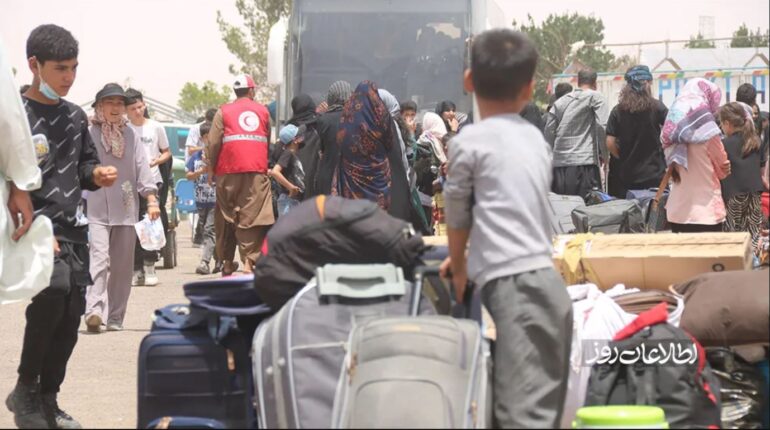

KABUL, AFGHANISTAN – Around 6.04 million Afghans have returned from Iran and Pakistan since mid-September 2023, the International Organization for Migration (IOM) said in an update released this week.
The “Afghanistan — Returnee Resilience Overview (Round 2, June 2026)”, based on a survey of 1,405 respondents, said nearly 951,000 undocumented returnees arrived from the two countries in the first half of 2025 alone.
The UN agency said the vast majority of returnees arrived in family groups, with 71% coming in households averaging 6.3 members. It added that 54% of assessed returnees were under the age of 18, sharply increasing demand for food, education, health care and protection services.
“Many returnees, some of whom have spent decades or even their entire lives abroad, arrive with limited social networks, unfamiliarity with local systems and norms, and constrained access to housing, livelihoods, services, civil documentation and protection mechanisms,” the report added.
According to the assessment, 54% of respondents said they could not meet basic needs with their income, while 95% had no productive assets or property for income generation. Shelter remains a major concern, with 79% living in transitional accommodation and 17% reporting eviction after returning.
Access to essential services remains limited, with 70% lacking meaningful access to heating resources, 66% to emergency services, and 50% each to health services and electricity.
Most returnees (81%) intend to stay in their current locations — mainly concentrated in Kunduz and Kabul provinces — but the IOM said this depends on improved access to livelihoods, shelter and services.
The mass return comes as Afghanistan faces one of the world’s worst humanitarian and human rights crises. Nearly half of the population need assistance, while women and girls remain stripped of most of their basic rights under Taliban rule.
The UN, aid agencies and rights groups has warned that without urgent international support and regional cooperation, the situation could escalate into a wider humanitarian disaster with serious consequences for Afghanistan and beyond.

