

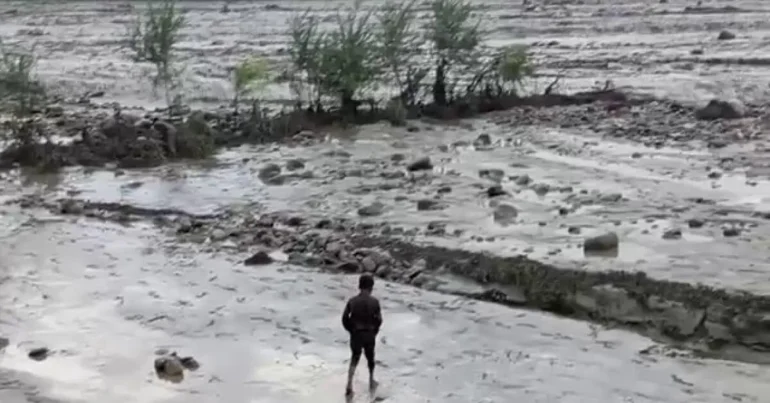

KABUL, AFGHANISTAN – Local Taliban authorities in Nangarhar province say that flash floods have caused casualties and significant property damage in the center and districts of the province.
Quraishi Badloon, Director of Information at the Taliban’s Department of Information and Culture in Nangarhar, said that yesterday on (Friday, June 26), hundreds of hectares of agricultural land and dozens of houses were destroyed by floods in Jalalabad city, the provincial center, and several districts of the province.
According to him, a 13-year-old child drowned while collecting firewood in the Akakhel area of Haska Mina district. With the help of local residents, the child’s body was recovered from the floodwaters.
Flood-affected residents are calling for immediate assistance.
The floods caused damage in the districts of Kama, Behsud, Surkh Rod, Khogyani, Shirzad, Pachir Aw Agam, Chaparhar, Dara-e-Noor, Kuz Kunar, Shinwari, Haska Mina, and Momand Dara. The exact extent of the damage has not yet been determined.
The Meteorological Department had earlier warned of heavy rainfall and possible flooding in 15 provinces.
The renewed disaster comes amid an unusually severe year of extreme weather in Afghanistan, marked by repeated heavy rainfall, flash floods, seasonal storms, and climate-related shocks linked to the ongoing El Niño phenomenon.
Earlier assessments by the United Nations Office for the Coordination of Humanitarian Affairs had already highlighted the scale of the crisis. According to an update published two months ago, heavy rainfall and flash floods between mid-March and late April affected more than 73,000 people across all 34 provinces of Afghanistan, leaving around 57,000 in urgent need of humanitarian assistance.
More than 10,000 families across Afghanistan have been affected by flooding since the beginning of 2026.
OCHA reported that the floods caused widespread destruction, particularly in eastern and southern regions, killing and injuring several hundred people overall. Around 1,500 homes were completely destroyed and another 6,000 damaged, while roads, bridges, farmland, and other key infrastructure suffered major losses.
Afghanistan is highly vulnerable to seasonal flash floods, particularly during periods of heavy rainfall. Limited infrastructure, inadequate flood protection measures, and the country’s mountainous terrain often increase the impact of such disasters, leaving affected communities in urgent need of humanitarian assistance.

