

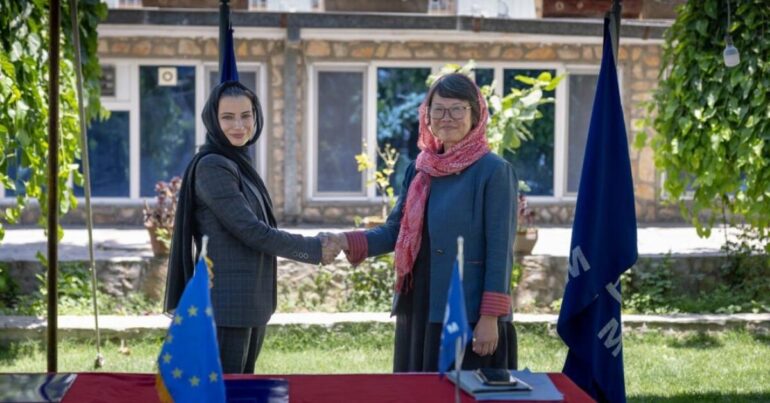

KABUL, AFGHANISTAN – The European Union has announced that it will allocate 20 million euros for assistance to returnees and displaced people in Afghanistan through the International Organization for Migration.
The European Union delegation in Kabul said in a statement on (Tuesday, June 23) that this financial support comes at a time when Afghanistan continues to experience one of the largest and most complex humanitarian crises in the world, and that the crisis has been further intensified by the high number of returns.
H.E. Veronika Bošković Pohar, Chargée d’Affaires of the European Union Delegation to Afghanistan noted: “The European Union remains firm in its commitment to support the reintegration of returnees in Afghanistan, helping them transition from dependency towards self-reliance.
She added : “Our partnership with IOM is central to this effort. Since 2022, the European Union has mobilised more than EUR 140 million to respond to the displacement crisis in Afghanistan through the provision of multisectoral assistance.”
“The European Union has been a longstanding partner of IOM in responding to displacement and return in Afghanistan. At a time when millions of Afghans continue to return to communities already struggling with limited resources and services, this contribution will enable IOM to expand critical support, strengthen livelihoods, support small businesses, and enhance access to essential services through Community Resource Centres, helping returnees and host communities build more resilient futures,” said IOM Afghanistan Deputy Chief of Mission, Mutya Maskun.
The European Union said that this assistance will expand integrated support for returnees, internally displaced persons, and host communities through protection services, health care, psychosocial support, livelihoods and recovery in high-return regions and provinces.
The EU delegation also said that this funding will support the sustainable reintegration of returnees, especially women and other vulnerable groups, through livelihood support, vocational training, and assistance to small and medium-sized enterprises.
According to the International Organization for Migration, from September 2023 to May 2026, more than 6.04 million migrants were deported from Iran and Pakistan and returned to Afghanistan.
The organization’s statistics show that only in 2025, 2.8 million migrants were deported from Iran and Pakistan and entered Afghanistan.
The International Organization for Migration said that these returns have increased Afghanistan’s population by at least ten percent and have intensified the country’s humanitarian crisis.
The rise in returns comes as Afghanistan faces a worsening humanitarian situation. UN estimates nearly 22 million people, close to half the population, require humanitarian assistance this year, while around 4 million children are suffering from acute malnutrition.
Many returnees are families who had been living in Pakistan and Iran for years or decades and now face difficulties reintegrating into communities with limited infrastructure and economic opportunities. Humanitarian organizations warn that without sustained support, returnees could face rising poverty and displacement inside Afghanistan.
Women and girls remain subject to strict restrictions on education, employment, and other basic rights, limiting household income and access to basic services for many families.
Human rights organizations and international aid agencies have repeatedly called on Pakistan and Iran to halt forced returns. They warn that returnees, particularly women, journalists, activists, and former government officials, risk security threats and possible retaliation upon re-entering Afghanistan under Taliban rule.

