

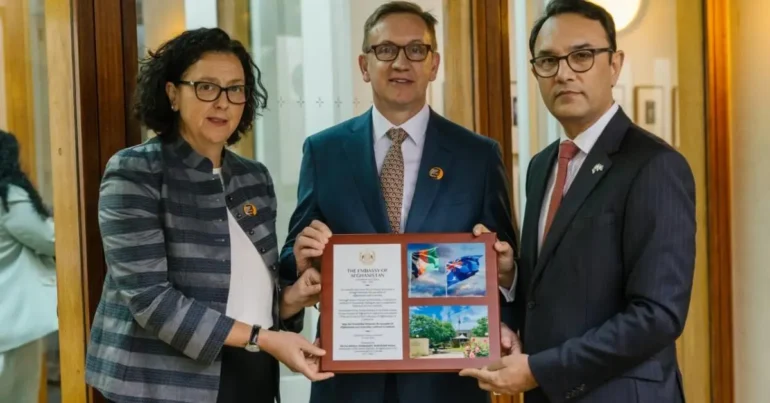

KABUL, AFGHANISTAN – The Embassy of Afghanistan in Canberra has announced that the “Parliamentary Friendship Group with the People of Afghanistan” has been launched in the Australian Parliament.
In a statement, the embassy said that the ceremony to relaunch the friendship group was held on Tuesday (24 June).
According to the statement, due to the absence of a legitimate government in Afghanistan, the body has been established under the title “Parliamentary Friendship Group with the People of Afghanistan.”
The Afghan Embassy in Canberra welcomed the creation of the friendship group and described it as “a sign of Australia’s continued friendship, solidarity, and commitment to the people of Afghanistan.”
The parliamentary group is led by Julian Hill, Member of Parliament and Australia’s Minister for Citizenship.
Speaking at the inauguration ceremony, Milton Dick, Speaker of the Australian Parliament, said that his country remains committed to the people of Afghanistan.
He emphasized that the “solidarity of the Australian Parliament with the people of Afghanistan” will continue.
Matt Thistlethwaite, Australia’s Assistant Foreign Minister, expressed concern over the human rights situation in Afghanistan, saying that Australia would continue to oppose any effort to normalize the country’s current conditions.
He added that Australia’s humanitarian assistance to the Afghan people and its support for the rights of women and girls will continue, and that the country will work to hold the Taliban accountable for human rights violations.
Monique Ryan, Co-Chair of the Friendship Group, also emphasized that the people of Australia, especially Australian women, stand in support of Afghan women and girls.
Wahidullah Waissi, Afghanistan’s ambassador, who has continued to lead the embassy since the former republic era, called for continued support for the Afghan people without endorsing Taliban policies.
He said that the people of Afghanistan and the Taliban are two distinct groups and that support for the Afghan people should not result in the endorsement of Taliban policies.
Mr. Waissi stated that “humanitarian assistance does not require recognition of the Taliban and should not be interpreted as normalizing the current situation.”
The Parliamentary Friendship Group with Afghanistan had previously existed, but following the collapse of the republic and the dissolution of Afghanistan’s parliament, it has now been reestablished as a friendship group with the people of Afghanistan.
About five months earlier, Australia and the Embassy of Afghanistan in Canberra issued a joint statement announcing that the embassy would suspend its operations after 30 June 2026. The statement also confirmed that Australia would not accept any Taliban-appointed diplomats or representatives. It noted that the decision followed consultations with the embassy, which has been run by officials from Afghanistan’s former government, and described the suspension as an “orderly and dignified transition.”
Both sides reaffirmed that they do not recognize the Taliban as the legitimate representatives of Afghanistan and condemned the group’s systematic human rights violations, particularly against women, girls, and dissenting voices.
Australia is one of the countries that has not handed over the Afghan embassy to the Taliban and does not maintain open relations with the group.
Since the Taliban regained power in August 2021, most of the international community has refrained from granting diplomatic recognition, citing concerns over human rights abuses, ties to terrorism, and the absence of an inclusive government. Russia remains the only country to formally recognize the Taliban, while several regional states maintain limited engagement without offering full recognition.
The establishment of the Parliamentary Friendship Group with the People of Afghanistan reflects a broader effort by some international partners to maintain engagement with Afghan society while avoiding formal recognition of the Taliban. The initiative underscores ongoing international concern over human rights, particularly the rights of women and girls, and highlights the continuing distinction many governments make between supporting the Afghan people and engaging with the Taliban authorities.

