

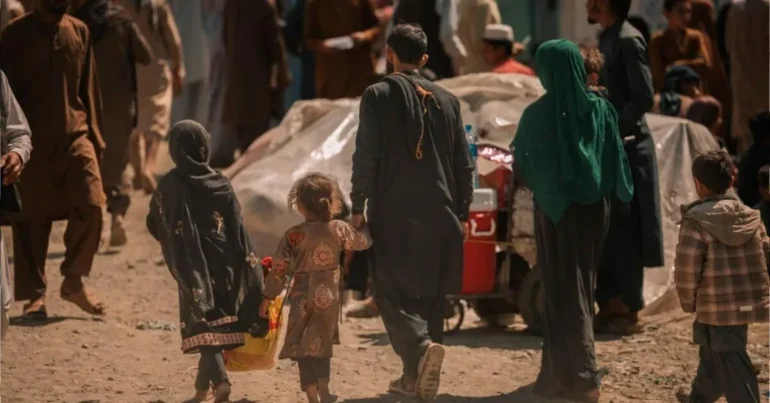

KABUL, AFGHANISTAN – Tajudeen Oyewale, the representative of the United Nations Children’s Fund (UNICEF), shared the newly released “2026 Response Plan for Afghan Returnees (RPAR)” on his official X account, warning that Afghanistan is currently experiencing one of the largest returnee crises in the world.
In his statement published on Saturday, 23 May 2026, he said that United Nations teams and humanitarian partners are working across Afghanistan to ensure that returnees, families, and children receive essential assistance, including healthcare, nutrition services, clean drinking water, food supplies, protection services, and emergency humanitarian support.
His remarks came as the United Nations and humanitarian agencies raised alarm over the rapidly increasing number of Afghans returning from Pakistan and Iran under worsening humanitarian and economic conditions.
The “2026 Response Plan for Afghan Returnees,” published by the United Nations and humanitarian partners, describes the situation as a multi-dimensional humanitarian emergency that has intensified dramatically since late 2023. According to the report, approximately 5.8 million Afghans have returned from neighboring countries since the launch of Pakistan’s Illegal Foreigners Repatriation Plan (IFRP) and the intensification of deportations from Iran.
The report states that these returns have increased Afghanistan’s population by nearly 10 to 12 percent in just over two years, placing enormous pressure on a country already struggling with poverty, drought, unemployment, food insecurity, and weakened public services.
The report further projects that between April and December 2026, another 2,696,500 Afghans are expected to return to Afghanistan, including around 1.1 million from Pakistan and approximately 1.59 million from Iran. Humanitarian agencies warn that many of these returnees are likely to arrive under distress conditions, with large numbers being deported or pressured to leave rather than returning voluntarily. The document notes that more than half of the projected returnees will be women and children, many of whom were born outside Afghanistan and have little or no social, economic, or family connections in the areas where they are expected to settle.
According to the report, many returnees have experienced severe protection violations before and during their journeys back to Afghanistan. Families interviewed during humanitarian assessments reported harassment, arbitrary detention, extortion, long waits at checkpoints, forced evictions, and fear of arrest in both Pakistan and Iran.
The report also explains that many returnees arrive in Afghanistan with no stable housing, limited financial resources, and no access to sustainable livelihoods, making them highly vulnerable to debt, homelessness, exploitation, and repeated displacement.
Meanwhile, the United Nations warns that Afghanistan’s absorption capacity is already critically overstretched. The report states that in severe scenarios, border crossings such as Torkham and Spin Boldak could once again receive up to 20,000 returnees per day, similar to previous peaks witnessed during earlier phases of Pakistan’s deportation campaign.
Humanitarian officials caution that without immediate international support, the growing influx could deepen poverty, fuel social tensions, increase competition over scarce resources, and create new cycles of displacement across the country.
In response to the worsening crisis, the United Nations and humanitarian organizations have launched a large-scale response plan requiring more than US$529 million in funding for 2026. The strategy includes emergency border assistance as well as long-term reintegration support for returnees inside Afghanistan. According to the report, more than US$100 million has been allocated for emergency border operations, while approximately US$428 million is required for reintegration programs in priority areas of return.
These programs are intended to support healthcare, nutrition, water and sanitation services, education, housing, livelihoods, transportation, psychosocial support, and protection services for vulnerable individuals and families.
The report explains that humanitarian operations at border crossing points are being coordinated through a consortium led by the International Organization for Migration in cooperation with agencies including United Nations High Commissioner for Refugees, United Nations Children’s Fund, World Food Programme, World Health Organization, and other humanitarian partners.
Services at the borders include hot meals, emergency shelter, transportation, health screening, vaccinations, psychosocial support, nutrition services for children and pregnant women, drinking water, protection monitoring, and cash assistance for vulnerable households.
Furthermore, the report highlights that women and girls face particularly severe challenges after returning to Afghanistan. Humanitarian assessments found that many women experience movement restrictions, limited access to healthcare and employment, and heightened risks of violence, discrimination, and social isolation.
The report states that female-headed households often struggle to access civil documentation such as Tazkira identity cards, which are essential for obtaining aid, healthcare, education, and legal protection. In many communities, women also remain excluded from local dispute resolution mechanisms, reducing their ability to resolve housing and land disputes or seek justice.
To identify the most vulnerable areas, the United Nations developed a Composite Vulnerability Index that combines factors such as returnee density, drought severity, food insecurity, and the number of internally displaced people already living in affected districts.
Through this assessment, 35 districts across Afghanistan were identified as priority areas requiring urgent intervention, including districts in Farah, Jawzjan, Kunduz, Kandahar, and Kabul. The report warns that without immediate investment in these areas, the massive return flows could overwhelm local infrastructure and public services, worsening already fragile humanitarian conditions.
The United Nations concludes in the report that the return crisis is no longer simply an issue of emergency border assistance, but a broader challenge of long-term reintegration and community survival.
Humanitarian agencies stress that without sustained international funding and coordinated support, Afghanistan risks facing a deeper humanitarian catastrophe marked by worsening poverty, rising unemployment, social instability, and renewed displacement in the months ahead.

