

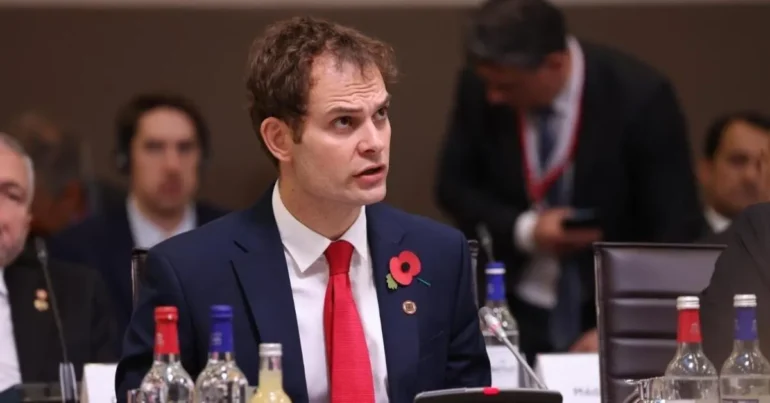

KABUL, AFGHANISTAN – Hamish Falconer, the United Kingdom’s Deputy Foreign Secretary for the Middle East and North Africa, says he is “appalled by reports” about the Taliban’s new laws that permit child marriage in Afghanistan.
Mr. Falconer wrote today (Monday, May 25) on X, referring to the recently published “Regulation on the Separation of Spouses” issued by the Taliban, that “child marriage is always and everywhere a breach of basic human rights.”
He emphasized that girls must be protected, not forced to endure harm and suffering.
The Taliban have introduced a new decree, officially titled the “Code on Judicial Separation of Spouses,” which establishes rules governing divorce, marital separation, and related family matters in Afghanistan. Approved by Hibatullah Akhundzada, the decree grants men the unilateral right to divorce while requiring women to go through restrictive and complex judicial procedures to seek separation.
The regulation also implicitly recognizes child marriage by allowing a girl’s silence upon reaching puberty to be interpreted as consent to marriage, raising serious concerns about forced and underage marriages. Critics say the decree reinforces legal inequality between men and women and further restricts women’s autonomy within marriage and family life.
The publication of this regulation has sparked widespread criticism from women’s rights activists, human rights defenders, and rights organizations.
United Nations Assistance Mission in Afghanistan expressed “grave concern,” warning that the decree deepens systemic discrimination against Afghan women and girls. UNAMA said the law reflects a broader pattern of eroding women’s rights since the Taliban’s return to power in August 2021.
While early Taliban decrees had formally recognized limited protections such as women’s consent to marriage and inheritance rights, UNAMA noted that subsequent measures have steadily undermined those protections. The mission particularly criticized provisions related to girls reaching puberty, warning that treating silence as consent violates international standards of free and full consent and fails to protect children’s best interests.
UNAMA urged the Taliban to align Afghan laws with international human rights commitments and end policies that institutionalize gender-based discrimination.
Earlier, a coalition of more than 100 human rights and women’s rights organizations called for immediate repeal of the regulation, arguing that it legitimizes child and forced marriage and weakens legal protections for women and minors.
In a joint statement, the groups said several articles of the code include provisions that could be interpreted as recognizing child and forced marriages, and criticized language that treats a girl’s silence after puberty as consent.
Taliban spokesperson Zabihullah Mujahid defended the decree, arguing it is based on the group’s interpretation of Islamic law and that external criticism is not important.
Since their return to power nearly five years ago, the Taliban have imposed some of the world’s most restrictive policies on women and girls. These include bans on secondary and higher education for girls, severe limits on female employment and travel without a male guardian, and wide-ranging exclusions from public and political life.
UN experts, rights groups, and activists have repeatedly said the scale and systematic nature of the Taliban’s restrictive measures amount to “gender apartheid,” describing them as an institutionalized system designed to subjugate women solely based on their gender.

