

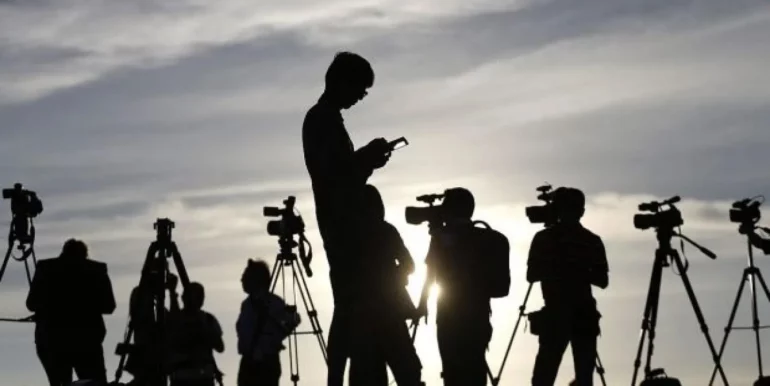

KABUL, AFGHANISTAN – A human rights organization, Rawadari, has stated on the occasion of World Press Freedom Day that the situation of access to information and freedom of expression in Afghanistan remains deeply concerning.
The organization said today (Sunday, May 3) that following the Taliban’s return to power, the activities of hundreds of media outlets have been halted, and a large number of journalists have either lost their jobs or been forced to leave the country.
Furthermore, Rawadari added that “during this period, a significant number of journalists have been detained, threatened, tortured, and even killed.” The organization emphasized that “In the absence of an effective legal framework to protect freedom of expression, the ruling authorities continue to impose extensive controls and stringent restrictions on media activities.”
Similarly, Richard Lindsay, the United Kingdom’s Special Representative for Afghanistan, marked World Press Freedom Day by highlighting the resilience of Afghan journalists.
In a post on X today (Sunday, May 3), he stated that journalists continue their vital work under extremely difficult conditions, amplifying the concerns and interests of the Afghan people and serving as a voice for those most in need. Lindsay, who met with several Afghan journalists in Kabul last week, also stressed the importance of freedom of expression.
At the same time, United Nations Secretary-General António Guterres underscored the fundamental importance of press freedom, stating that “all freedoms depend on press freedom.”
In his message marking the day, he wrote: “And when journalism is undermined, crises become far more difficult to prevent and resolve. Without it, there can be no human rights, no sustainable development – and no peace.”
Guterres further called for the protection of journalists, urging the global community to “let us protect the rights of journalists, and build a world where the truth – and truth-tellers – are safe.”
He also highlighted the dangers journalists face, noting that while it is often said that truth is the first casualty of war, “but far too frequently, the first casualties are the journalists who risk everything to report that truth – not only in war, but wherever those in power fear scrutiny.”
In addition, he pointed out that media workers worldwide face threats such as censorship, surveillance, legal harassment, and even death. He noted a sharp rise in journalist killings in recent years, particularly in conflict zones, emphasizing that 85 percent of crimes against journalists go uninvestigated and unpunished—an unacceptable level of impunity.
He also warned that economic pressures, new technologies, and active manipulation are placing unprecedented strain on press freedom, adding that when access to reliable information disappears, distrust grows and social cohesion weakens.
Moreover, the United Nations, in a separate statement marking World Press Freedom Day, stressed that access to reliable and verified information is not a choice but a fundamental condition for building peaceful, just, and sustainable societies. The organization reaffirmed its commitment to protecting freedom of expression and supporting journalism as a cornerstone of peace, stating that journalism plays a decisive role in shaping and strengthening peace.
The UN also warned about the consequences of information distortion, noting that it undermines social cohesion and gradually erodes public trust. It emphasized that when information is free and truth-based, it enhances accountability, fosters constructive dialogue, and protects human rights.
Meanwhile, in Afghanistan, since the Taliban’s return to power, access to information has been severely restricted, and sweeping limitations have been imposed on media and journalists. The group has repeatedly raided media offices, detained journalists and media workers, and shut down media operations.
Since the Taliban takeover, authorities have issued more than 20 directives regulating media activity, content approval, and access to information. These measures have contributed to the near-collapse of what was once a vibrant media sector, with dozens of outlets shut down or silenced and hundreds of journalists forced into exile or hiding.
Afghanistan ranked 175th out of 180 countries in Reporters Without Borders’ 2026 World Press Freedom Index, placing it among the worst globally.
The protection of journalists and the preservation of access to truthful information are not only essential for safeguarding human rights but also for ensuring peace, accountability, and the functioning of any just society.

