

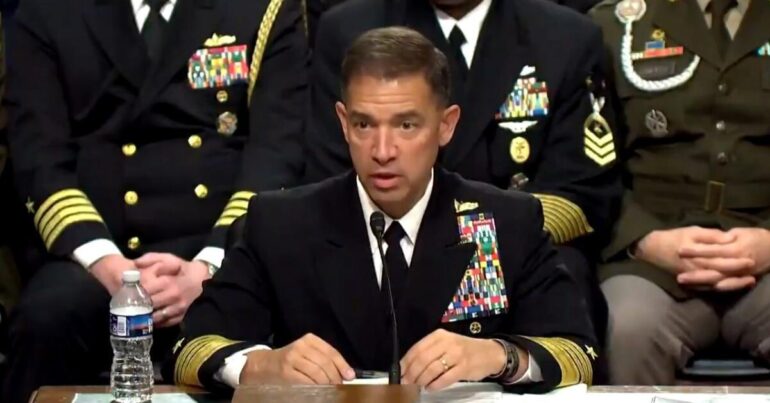

KABUL, AFGHANISTAN – Pakistan plays a key role as a counterterrorism partner in efforts against Islamic State Khorasan Province (ISIS-K), the commander of U.S. Central Command (CENTCOM) said, warning that terrorist threats originating from Afghanistan continue to concern the United States and its allies.
Admiral Charles Bradford “Brad” Cooper II told the U.S. Senate Armed Services Committee on Thursday that cooperation with Pakistan and other regional partners remains central to the U.S. approach to countering militant threats following the withdrawal of American forces from Afghanistan in 2021.
“The terrorist threats originating from Afghan soil remain an important factor in U.S. cooperation with regional partners,” Cooper said, adding that Washington’s approach depends on “a set of regional partnerships” rather than a permanent military presence.
“Pakistan is a key counterterrorism partner that plays a central role in the fight against ISIS-K in the region,” Cooper said. “Our strong military-to-military partnership with Islamabad has produced tangible results against high-value individuals with American blood on their hands.”
Cooper also noted that countries in Central Asia are closely monitoring Afghanistan-linked militant activity. “Our partners in Central Asia are keeping a wary eye towards Afghanistan-based terrorist threats,” he said.
The Taliban authorities say they have brought security to Afghanistan and deny that foreign militant groups operate from its territory. Taliban spokesperson Zabihullah Mujahid has said ISIS-K has been defeated inside the country and that remaining elements operate from neighboring states.
However, ISIS-K has continued to claim responsibility for attacks inside Afghanistan in recent years. United Nations experts and monitoring bodies have said the group remains active and continues to pose a significant regional security threat.
A December 2025 report by the U.N. Security Council’s Analytical Support and Sanctions Monitoring Team said ISIS-K has not been eliminated and continues to pose “serious threats within Afghanistan, the region, and beyond,” despite Taliban countermeasures.
The U.S. military withdrawal in August 2021 ended two decades of involvement in Afghanistan. Since then, Washington has maintained an “over-the-horizon” counterterrorism posture, relying on intelligence capabilities, limited strikes when necessary, and cooperation with regional partners.
U.S. officials have repeatedly warned that instability in Afghanistan could allow militant groups such as ISIS-K and al Qaeda affiliates to regroup and potentially plan external attacks, while regional governments have also raised concerns about cross-border militancy and spillover violence.

