

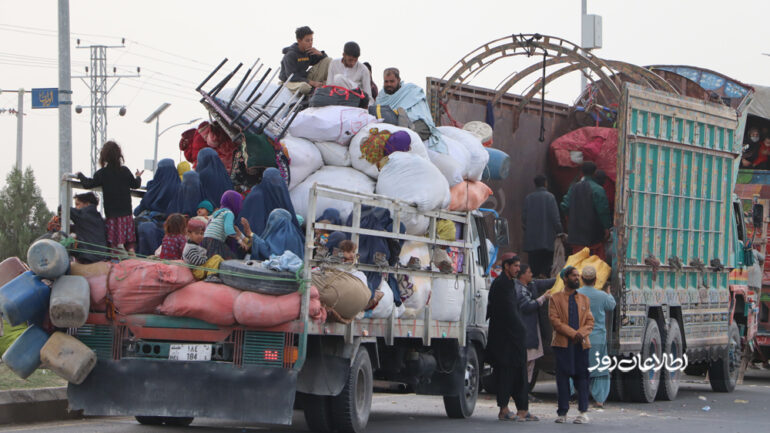

KABUL, AFGHANISTAN – More than 19,000 Afghans have returned from Pakistan in the past four days, Taliban authorities said, as Islamabad intensifies its nationwide crackdown on Afghan refugees amid ongoing tensions with the Taliban over cross-border militancy.
According to figures released by the Taliban’s Commission for Refugee Affairs and compiled by KabulNow, a total of 19,317 Afghans were either deported or returned voluntarily between Monday and Thursday.
The commission said 4,211 Afghans crossed into Afghanistan on Monday, 4,559 on Tuesday, 5,589 on Wednesday, and 4,958 on Thursday.
Most returnees entered through the Torkham border crossing in eastern Nangarhar province, a key transit point between the two countries. Others crossed through the Spin Boldak crossing in southern Kandahar province, according to the commission.
The commission also reported that 1,863 Afghans returned from Iran during the same period through the Islam Qala crossing in western Herat province and the Pul-e-Abrisham crossing in Nimroz province.
Pakistan has stepped up deportations in recent weeks and months, with security forces carrying out widespread raids, detentions, and expulsions targeting undocumented Afghans. The move comes amid ongoing tensions between Islamabad and the Taliban over alleged cross-border militancy.
According to the U.N. refugee agency, UNHCR, nearly 270,000 Afghans returned from Pakistan and Iran between January and March this year. More than five million Afghans have returned from the two neighboring countries since late 2023.
The large-scale returns are increasing pressure on Afghanistan’s already fragile economy and humanitarian situation. Years of conflict, economic isolation, recurring natural disasters, and restrictions imposed by the Taliban have left millions reliant on humanitarian assistance.
A recent report by the U.N. Development Programme (UNDP) painted a grim picture for returnees. It found that 92% of recent returnees were unable to secure basic necessities such as food, shelter and healthcare. It also said that in communities hosting returnees, only 3% of people have formal employment, while 78% rely on casual day labour.
Aid groups have warned that continued large-scale returns without sustained international assistance could deepen poverty, increase unemployment, and contribute to further internal displacement inside Afghanistan.
Women and girls are considered particularly vulnerable under Taliban rule due to restrictions on secondary and higher education, most forms of employment, and participation in public life.
Human rights groups and international aid agencies continue to call on Pakistan and Iran to halt forced returns, citing the worsening humanitarian crisis and security risks faced by returnees, particularly women, journalists, activists, and former government officials under Taliban rule.

