

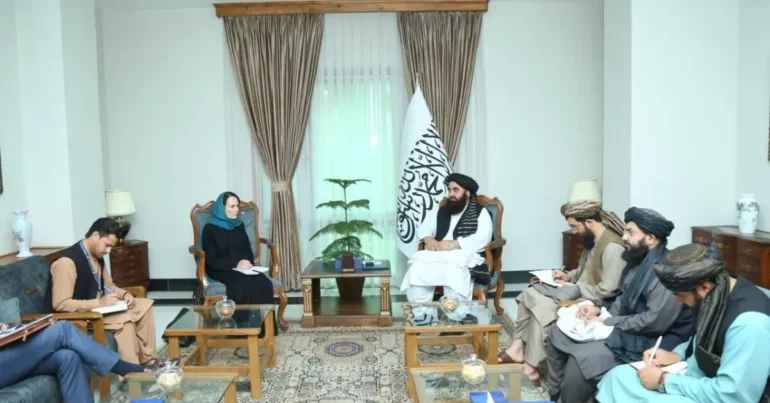

KABUL, AFGHANISTAN – Amir Khan Muttaqi, the Taliban’s acting foreign minister, has called for the presence of a Taliban representative at the United Nations and other international organizations during a meeting with Georgette Gagnon, the Deputy Special Representative for Political Affairs and acting head of the United Nations Assistance Mission in Afghanistan (UNAMA).
According to a statement issued by the Taliban’s Ministry of Foreign Affairs, during the meeting held on Tuesday (May 19), Muttaqi said that the presence of a representative of the group at the United Nations and other organizations would help strengthen and further expand effective engagement.
Afghanistan’s representation at the United Nations is currently held by Nasir Ahmad Faiq, a diplomat appointed by the former Afghan government.
The United Nations has so far refused to hand over Afghanistan’s seat to the Taliban due to the group’s lack of domestic and international legitimacy.
The Taliban’s Ministry of Foreign Affairs said that Muttaqi also discussed the upcoming meeting of the United Nations Security Council on Afghanistan with the acting head of UNAMA, but did not provide further details.
The ministry added that Gagnon emphasized increasing engagement and cooperation between the international community and Afghanistan under Taliban control in various fields.
According to the statement, at the end of the meeting, both sides stressed the coordination of joint working committees to further strengthen cooperation in humanitarian areas and mutual engagement.
The United Nations has established several joint working groups with the Taliban under the framework of the Doha process for Afghanistan.
These groups have been active in areas including counter-narcotics efforts and support for the private sector, and several joint meetings have been held so far.
However, reacting to Muttaqi’s request, Nasir Ahmad Faiq, head of Afghanistan’s mission to the United Nations, questioned the basis on which the Taliban are demanding control of Afghanistan’s seat at the United Nations.
Writing on X today (Wednesday, May 20), Faiq said: “On what basis of positive action and what criterion of legitimacy are the Taliban seeking the handover of Afghanistan’s seat in the United Nations?”
He wrote that representation at the United Nations is the legitimate right of governments that have obtained power and sovereignty through legitimate means based on the will of the people, guarantee the rights of citizens without gender, ethnic, or religious discrimination within the framework of law, and remain committed to their national and international obligations.
He added: “The Taliban regime, after five years, has neither responded positively to the legitimate demands of the people of Afghanistan nor addressed the clear expectations of the international community.”
Nasir Ahmad Faiq further stated that girls are still barred from attending schools and universities, women continue to be denied the right to work and participate in society, and Afghanistan remains without a legitimate and inclusive national system. He said corruption and repression have deepened, while security conditions in Afghanistan and the wider region have deteriorated due to the presence and support of international terrorist groups.
He also noted a sharp rise in poverty, forced marriages, youth suicides linked to unemployment, targeted killings of former security personnel, restrictions on freedom of expression, the spread of jihadist educational institutions, and the growing promotion of extremism and violence. He questioned what concrete achievements or legitimate grounds the Taliban could cite in seeking control of Afghanistan’s seat at the United Nations.
Following the Taliban takeover, the UN deleted the names of Ashraf Ghani as president of Afghanistan and Hanif Atmar, the former foreign minister, from its official protocol list, leaving the place blank but retaining the Islamic Republic of Afghanistan as the country’s official designation.
Securing international recognition has been a primary foreign policy objective for the Taliban since seizing power in Afghanistan. While their efforts have met with limited success overall, China’s recognition of their ambassador’s credentials on December 1, 2023, was celebrated by the group as an “important chapter”.
The issue of Afghanistan’s representation at the United Nations remains one of the most contentious diplomatic disputes since the Taliban’s return to power, reflecting the deep divide between the group’s pursuit of international recognition and the continuing concerns of Afghan representatives and the wider international community over legitimacy, governance, and human rights.
However, with the exception of Russia, which has taken limited formal steps toward recognizing the Taliban administration, no major country or the United Nations has officially granted full international recognition to the regime.
The Taliban continue to face widespread criticism for systematic human rights violations, particularly their treatment of women and girls. Leading human rights organizations, including Human Rights Watch and Amnesty International, have described the Taliban’s policies as amounting to “gender apartheid,” citing the near-total exclusion of women and girls from secondary and higher education, bans on most forms of employment, restrictions on movement without a male guardian, and severe limitations on public participation. These measures are considered among the harshest institutionalized restrictions on women’s rights anywhere in the world.
In addition, international monitoring bodies and regional governments have repeatedly raised concerns about the continued presence and operational freedom of militant groups such as Al-Qaeda, Tehreek-e-Taliban Pakistan (TTP), and regional affiliates of Islamic State Khorasan Province (ISKP) inside Afghanistan. Reports from United Nations monitoring teams have warned that these groups continue to exploit Afghan territory for recruitment, coordination, and cross-border activities, raising serious regional and international security concerns, although the Taliban have consistently denied providing sanctuary or support to such organizations.

