

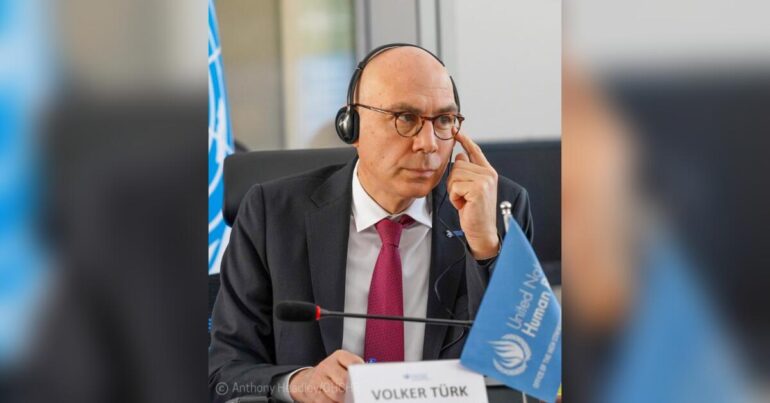

KABUL, AFGHANISTAN – The United Nations High Commissioner for Human Rights, Volker Türk, has warned that the ongoing forced deportation of Afghan migrants and asylum-seekers from host countries violates international human rights and refugee law.
In a press release on Friday, Türk said involuntary returns to Afghanistan have intensified in 2026, with UNHCR figures showing nearly 270,000 Afghans deported since the beginning of the year. The majority were returned from Iran and Pakistan, with smaller numbers from Türkiye and Tajikistan.
Türk said Afghan women, children and men are being forced back to a country where they did not choose to return and where conditions remain highly dangerous. He said such returns expose people to “grave risk” upon arrival.
Citing a joint report by the UN Assistance Mission in Afghanistan (UNAMA) and the Office of the High Commissioner for Human Rights, Türk noted that some involuntarily returned Afghans have faced arbitrary arrest, detention, torture and ill-treatment by Taliban authorities.
The report identified women and girls, former government officials and security force members, journalists, civil society workers, and members of the LGBTIQ+ community as being at particular risk of reprisals and human rights violations upon return.
Türk stressed that forced returns are incompatible with the principle of non-refoulement under international law, which prohibits sending individuals back to places where they face serious harm. He called on states to ensure individualized risk assessments before any deportations and to avoid actions that could lead to irreparable harm.
He also raised concerns about reports that some European countries are reviewing or resuming deportations to Afghanistan despite the ongoing human rights situation. He said such decisions should not proceed without careful legal safeguards.
“I strongly caution against all involuntary returns to Afghanistan in the absence of individualized risk assessments, which are required by and must be carried out in accordance with international human rights and refugee law,” the High Commissioner said.
The UN rights chief also pointed to Afghanistan’s worsening humanitarian and security situation, including cross-border tensions and an escalation of hostilities since October 2025. He said civilian casualties increased in the last quarter of the year amid clashes between Pakistan and the Taliban, marking the highest levels recorded since the Taliban’s return to power.
According to UN estimates, about 5.9 million Afghans have either returned or been forcibly deported from Pakistan and Iran since late 2023, including around 2.9 million in 2025 alone. Smaller-scale deportations have also been reported from Tajikistan and Türkiye.
The European Commission is also reportedly preparing to host a Taliban delegation in Brussels for talks on facilitating the deportation of Afghans whose asylum applications have been rejected or who have been convicted of crimes in Europe. The Commission has confirmed that discussions are being planned but has not yet announced a date.
The reported engagement has drawn criticism, including from members of the European Parliament, who say such talks risk normalizing a regime responsible for serious human rights violations and severe restrictions on women’s rights.

