

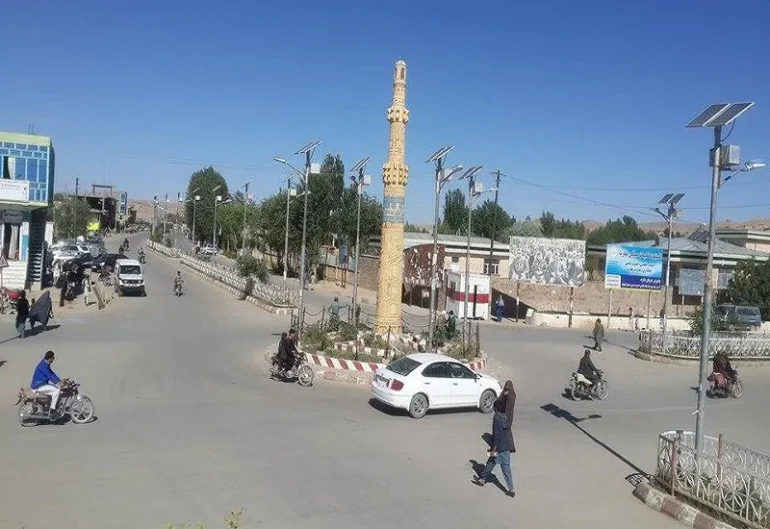

KABUL, AFGHANISTAN – The BBC World Service, in a report on the condition of residents in Ghor province, writes that poverty and unemployment have spread to such an extent that parents are being forced to sell their children, and newborn babies are dying after birth due to their mothers’ malnutrition.
A BBC reporter, describing the situation of poverty and hunger in Firozkoh, the center of Ghor province, wrote: “When a local bakery near the square opens up, the owner distributes stale bread among the crowd. Within seconds, the loaves have been pulled apart, half a dozen men clutching onto precious pieces.
Suddenly another scrum occurs. A man on a motorcycle comes by wanting to hire one labourer to carry bricks. Dozens of men throw themselves at him. In the two hours we were there, only three men got hired.”
The report adds that the poverty and unemployment situation in surrounding villages is even worse.
Abdul Rashid Azimi, who has two seven-year-old twin daughters named Razia and Rahila, wants to sell one of them.
Holding his twin daughters in his arms, Abdul Rashid cries and says he is forced to make difficult decisions: “I’m willing to sell my daughters,” he weeps. “I’m poor, in debt and helpless.”
He adds: “I come home from work with parched lips, hungry, thirsty, distressed and confused. My children come to me saying ‘Baba, give us some bread’. But what can I give? Where is the work?”
He takes one of his daughters in his arms, kisses her, and while crying says: “If I sell one daughter, I could feed the rest of my children for at least four years.”
Kaihan, the twins’ mother, says: “All we have to eat is bread and hot water, not even tea.”
Two teenage sons of this family polish shoes in the city. Another collects garbage, which their mother uses as fuel.
Saeed Ahmad, another resident of Ghor, has sold his five-year-old daughter because of poverty.
Saeed Ahmad said that his daughter, Shayeqa, was suffering from appendicitis and a liver cyst, and because the family could not afford her medical treatment, he was compelled to sell her to one of his relatives in order to cover the cost of her care.
Shayeqa’s surgery was successful, and the cost of her treatment was covered by the 200,000 Afghanis paid as her price.
Saeed Ahmad says the last time they received food assistance, including flour and oil, from an organization was two years ago.
Mohammad Hashim, another resident of Ghor, says that a few weeks ago, his 14-month-old baby died due to “hunger and lack of medicine.”
A local elder says child deaths due to malnutrition have sharply increased over the past two years.
The BBC reporter writes that in the cemetery of this area, the number of small graves is almost twice the number of large graves.
During a visit to Ghor provincial hospital in Firozkoh, the reporter noticed that a pair of twin newborns had been born two months prematurely; one weighed two kilograms and the other only one kilogram. The heavier baby died before even being given a name.
Fatima Hosseini, a nurse in the neonatal ward, said that the infant mortality rate in the province has reached 10 percent, and in most cases the primary cause is the weakness and malnutrition of mothers.
Juma Khan, 45, has found just three days of work in the past six weeks that paid between 150 to 200 Afghani ($2.35-$3.13; £1.76-£2.34) per day.
“My children went to bed hungry three nights in a row. My wife was crying, so were my children. So I begged a neighbour for some money to buy flour,” he says.
“I live in fear that my children will die of hunger.”
Khwaja Ahmad is an ordinary laborer interviewed by BBC journalists.
This elderly man, who sits for hours by the roadside each day hoping someone will take him for work, begins to cry before he can even say a few words.
“We are starving. My older children died, so I need to work to feed my family. But I’m old, so no one wants to give me work,” he says.
The United Nations, in a report on poverty in Afghanistan, says that three out of every four people cannot meet their basic living needs. Unemployment is widespread, the health system is under severe pressure, and international aid meets only a small fraction of the need.
According to the UN report, since the Taliban returned to power, Afghanistan has faced “the highest level of hunger” in its history; around 4.7 million people, more than 10 percent of the population, are only one step away from famine.
The situation in Ghor reflects the broader humanitarian crisis unfolding across Afghanistan, where economic collapse, prolonged unemployment, shrinking international assistance, and severe pressure on public services have left millions struggling for survival.
Afghanistan remains one of the world’s largest humanitarian emergencies, with nearly 22 million people requiring assistance this year, according to the UN estimates. Women and children are among the most affected. The World Food Programme projects that about 3.7 million children and 1.2 million pregnant and breastfeeding women will face acute malnutrition in 2026.
Humanitarian organizations have repeatedly warned that without urgent and sustained support, worsening food insecurity and malnutrition could push more vulnerable families into desperate choices, including child sales and other harmful coping mechanisms.

