

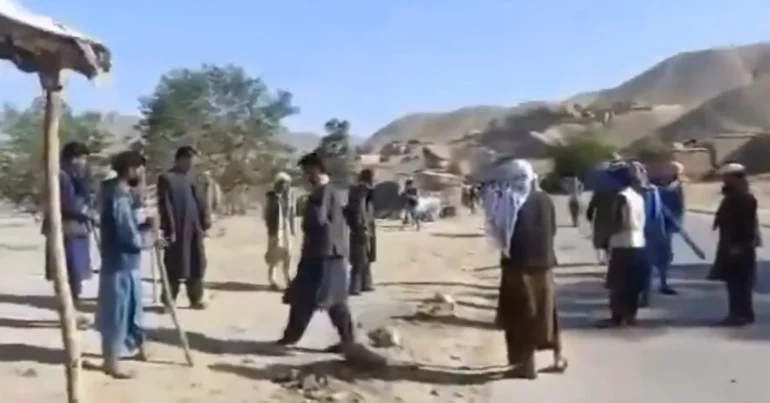

KABUL, AFGHANISTAN – The Taliban’s police command in Badakhshan has confirmed that at least two people were killed during protests over the destruction of poppy fields in Argo District of the province.
Ehsanullah Kamgar, spokesperson for the Taliban’s police command in Badakhshan, confirmed the casualties today (Saturday, May 9) and described the protesters as “rioters.”
He said that the group’s counter-narcotics unit went to the village of Aten Jelo in Argo District yesterday to destroy poppy fields, but a number of farmers and local residents, “incited by criminal individuals and drug traffickers,” attempted to prevent the destruction of the fields, and as a result of the tensions, one child was killed.
The spokesperson for the Taliban’s police command in Badakhshan added that today, a number of residents of the same village, “incited by malicious individuals and drug trafficking networks,” staged “protests and unrest,” during which one person was killed.
He also said that the protesters temporarily blocked the Kishm–Faizabad highway today, but through the efforts of local Taliban officials, religious scholars, and tribal elders, the highway was reopened.
The spokesperson claimed that the situation in the area is currently “normal” and that conditions are under the control of the group’s forces.
Earlier, local sources had reported that two residents of Aten Jelo village in Argo District were killed as a result of “gunfire by Taliban forces,” and several others were injured.
Local residents accuse the Taliban of harassing them “under the pretext” of destroying poppy fields and treating them in an “insulting” and “humiliating” manner.
Residents of Badakhshan in northeastern Afghanistan have repeatedly clashed with Taliban forces in recent years over the destruction of poppy fields. In previous years, several local residents were also killed and injured in shootings by the Taliban’s counter-narcotics forces. The main centers of these clashes have been Darayim and Argo districts.
The latest confrontation reflects deep-rooted tensions in Badakhshan, where repeated anti-narcotics crackdowns have often collided with the economic realities of local communities that depend on poppy cultivation for survival. The recurring clashes also highlight broader grievances over governance, local treatment by authorities, and the lack of viable economic alternatives for rural residents in the province.
These incidents reflect a long-standing cycle of mistrust between local residents and authorities, where economic hardship, limited livelihood alternatives, and strict enforcement measures have contributed to recurring protests and clashes. Critics argue that heavy-handed approaches to enforcement have at times intensified local resentment, while authorities maintain that the operations are part of national efforts to curb drug production.

