

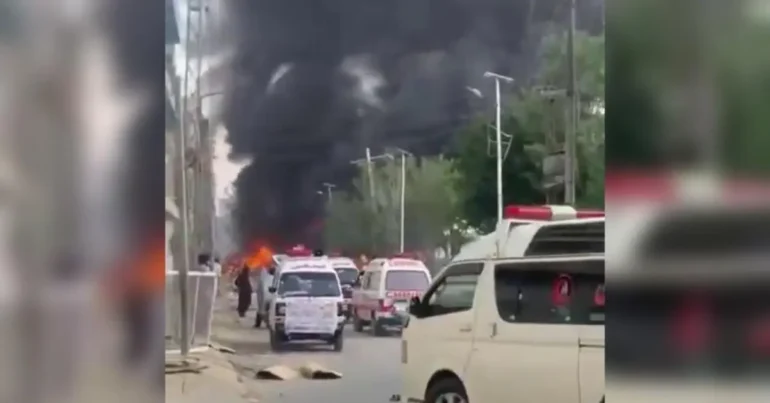

KABUL, AFGHANISTAN – Dozens of people have been killed and injured following an attack involving a car bomb targeting a passenger train in Quetta, Pakistan.
Agence France-Presse reported that the incident took place this morning (Sunday, May 24) in the Chaman Patak area after a bomb-laden vehicle collided with the Jaffar Express passenger train.
A local publication in Pakistan’s Balochistan province reported that at least 30 people were killed and another 70 were injured in the attack.
Following the collision of the bomb-laden vehicle with the train, several carriages derailed and overturned.
According to reports, the passenger train was traveling toward Peshawar, and Pakistani soldiers were also on board.
However, women and children are also among the victims of the incident.
Local media have attributed the attack to the Baloch Liberation Army.
Last year, Baloch militants took dozens of passengers on the Jaffar Express hostage.
The deadly train bombing in Quetta comes at a time when security dynamics in the broader Afghanistan–Pakistan region remain highly unstable, with both countries facing overlapping security and political challenges.
Since the Taliban took control of Afghanistan in 2021, the regional security environment has shifted significantly, affecting border management, militant mobility, and counterterrorism cooperation between the two neighbors.
Pakistan has seen a surge in militant violence in recent years, particularly in the provinces of Khyber Pakhtunkhwa and Balochistan, which border Afghanistan. The attacks often target security personnel, police patrols, military convoys, and government installations.
Militant groups, including Tehrik-i-Taliban Pakistan and the Baloch Liberation Army, as well as affiliated factions, have intensified attacks in these regions in recent years. Pakistani authorities say the groups have expanded operations against security forces, infrastructure, and government facilities.
Islamabad accuses the Taliban authorities in Afghanistan of allowing militants from Tehrik-i-Taliban Pakistan to use Afghan territory as a base to launch cross-border attacks. Taliban deny the accusations and say Pakistan should address its security challenges internally.
The rise in violence has strained relations between Pakistan and the Taliban authorities in Kabul. For years, Pakistan maintained close ties with the Afghan Taliban and hosted many of the movement’s leaders and fighters during the two decades of war against the Western-backed Afghan government that preceded the Taliban’s return to power in 2021.
In recent months, however, relations have deteriorated sharply, with both sides exchanging accusations and military actions along the border. Pakistan has carried out several airstrikes in border areas and, in some cases, deeper inside Afghanistan.
The attack underscores the continuing security challenges facing Pakistan’s southwestern region, where insurgent violence has intensified in recent years. The instability in Balochistan has broader regional implications, particularly for neighboring Afghanistan, as cross-border insecurity often disrupts trade routes, refugee movements, and economic ties between the two countries.

