

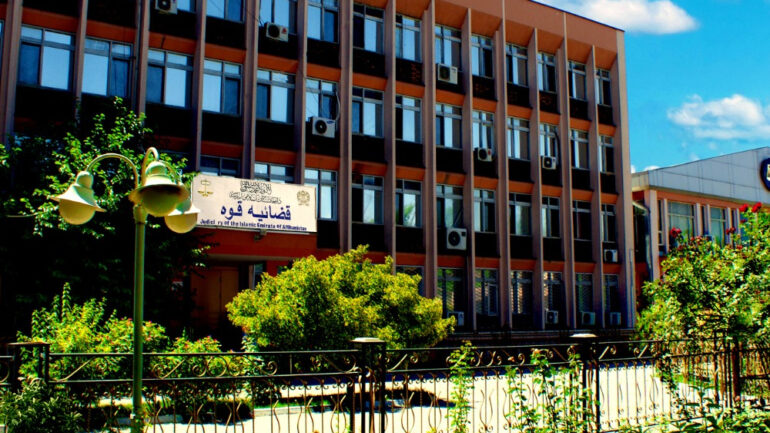

KABUL, AFGHANISTAN – The Taliban Supreme Court has claimed that it has addressed more than 4,000 cases related to women’s rights over the past three months of the current lunar year.
In a statement released today (Sunday, April 26), the court said that it had handled 4,021 cases concerning women’s rights.
According to the statement, these cases were related to inheritance and women’s property rights, as well as the registration of property documents in women’s names.
The Taliban Supreme Court stated that among these, 1,275 cases were related to “ownership and inheritance,” 2,462 cases concerned the “registration of property documents in a woman’s name where her dowry had been determined,” and 284 cases were related to women “obtaining property and inheritance documents.”
This comes as the Taliban, since regaining control of Afghanistan, have imposed widespread restrictions on women’s access to their fundamental rights.
Human rights activists and international organizations have repeatedly described the Taliban’s policies toward women as a form of “gender apartheid,” arguing that the systematic restrictions go far beyond cultural or administrative measures and instead represent institutionalized exclusion.
Since returning to power, the Taliban have imposed sweeping bans on girls’ secondary and higher education, barred women from many forms of employment, and restricted their movement and participation in public life.
Critics say these measures effectively confine women to the private sphere and erase their presence from key social, political, and economic spaces. Human rights groups warn that such policies not only violate fundamental freedoms but also risk creating long-term structural inequality that will deeply affect Afghan society for generations.
In a related development, a report by the United Nations Office for the Coordination of Humanitarian Affairs (OCHA) noted that the Taliban have issued at least 470 decrees since taking power in August 2021, with 79 of them directly targeting women and girls.
According to the report, these measures include bans on secondary, higher, and medical education for women, strict dress codes, and prohibitions on women working with non-governmental organizations. The UN further stated that these policies have significantly reduced women’s access to livelihoods and essential services and have had a profound impact on Afghanistan’s socio-economic structure.
This broader framework of restrictions helps explain the continuing limitations faced by women in legal, educational, and professional spheres, as reflected in the recent cases reportedly handled by the Taliban Supreme Court.
These developments highlight a broader contradiction between the Taliban’s claims of addressing women’s legal and property rights and the extensive limitations they continue to impose on women’s education, employment, and participation in society.

