

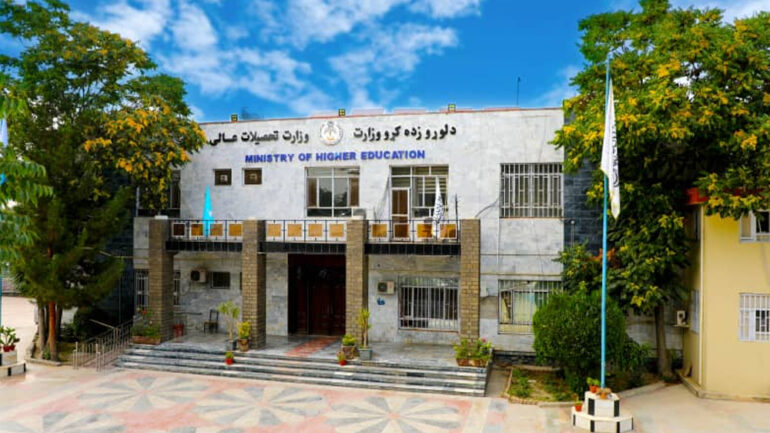

KABUL, AFGHANISTAN – The Taliban’s Ministry of Higher Education has confirmed that “Syed Jamaluddin Afghan” University in Kunar province came under a “rocket attack” by Pakistan this afternoon (Monday, April 27).
In a statement, the ministry said that around 30 university lecturers and students were wounded in the attack, and that the university’s buildings and surrounding areas sustained extensive damage.
Earlier, local sources had told Etilaat Roz and KabulNow that Pakistan targeted the Faculty of Education at Kunar University in an “airstrike.” Images and videos published on social media also show that parts of the university were damaged in the attack.
Pakistan also targeted areas in Asadabad city, the center of Kunar province, as well as Sarkano, Dangam, and Manogai districts. Local Taliban officials said that at least four people were killed and 70 others, including 30 students, were wounded in these attacks.
The attacks have drawn reactions from Afghan political figures. Hamid Karzai, the former president of Afghanistan, condemned Pakistan’s recent strikes on targets in the country, including Kunar University, saying that he considers these attacks to be “part of Pakistan’s policy to destroy the foundations of education and development in Afghanistan.”
In a post on X this evening, Karzai wrote that previous Pakistani attacks had also deprived students in the village of “Barikot” in Nari district of Kunar province of access to education.
The former president called on the United Nations to seriously investigate and condemn Pakistan’s attacks on Afghanistan and to take urgent steps to stop them.
Pakistani officials have not yet commented on the latest attacks.
The latest incident forms part of a broader escalation along the Afghanistan-Pakistan border that began in late February 2026. Kunar province, which shares a long and mountainous border with Pakistan’s Khyber Pakhtunkhwa region, has been one of the most frequently targeted areas, facing repeated rocket fire, artillery shelling, and airstrikes in recent weeks.
The United Nations previously verified 289 civilian casualties in Afghanistan from Pakistani strikes between late February and mid-March, including 76 killed and 213 injured, many of them women and children. Taliban authorities have reported significantly higher figures, claiming 761 killed and 626 injured as of early April during the peak of the clashes. The violence has also contributed to widespread displacement and damage to civilian infrastructure, including schools and health facilities.
The renewed attacks occurred despite ongoing diplomatic initiatives and local mediation efforts. Tribal elders from Afghanistan’s Sarkano district and Pakistan’s Bajaur district have recently engaged in talks aimed at securing a ceasefire and de-escalating the situation.
Taliban and Pakistani officials had also reached understandings in China-mediated talks in Urumqi to avoid actions that could escalate tensions, but both sides continue to accuse each other of violating agreements, with clashes persisting in several border areas.

