

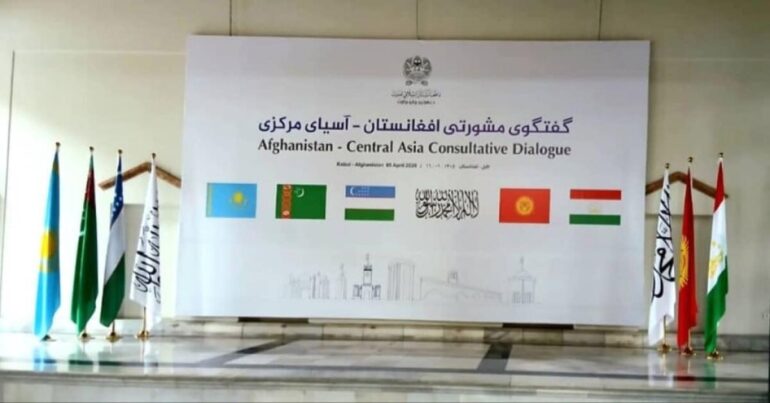

KABUL, AFGHANISTAN – The Taliban have announced that the “Afghanistan–Central Asia Consultative Dialogue” is scheduled to be held today (Sunday, April 5) in Kabul.
Hamdullah Fitrat, the Taliban’s deputy spokesperson, said that the meeting will be attended by high-ranking representatives of Central Asian countries and will be chaired by Amir Khan Muttaqi, the Taliban’s foreign minister.
He added that “political, economic, and security issues, as well as the development of regional cooperation, trade, and transit” will be discussed and reviewed during the meeting.
Since regaining control of Afghanistan, the Taliban have maintained extensive political and economic relations with Central Asian countries.
During this period, multiple bilateral and multilateral meetings have been held between the two sides, with an emphasis on expanding cooperation.
In a related development three months ago, a joint statement issued after the seventh round of the China–Pakistan Strategic Dialogue in Beijing highlighted regional expectations from the Taliban authorities. China and Pakistan agreed to work with the international community to encourage the Taliban to establish an inclusive political system, adopt moderate policies, and contribute to Afghanistan’s sustainable development and integration into the global community.
They also emphasized the importance of good neighbourly relations and a constructive role in maintaining regional stability, aligning with broader efforts to strengthen cooperation between Afghanistan and its neighboring regions.
Such meetings are seen as part of broader regional efforts to strengthen connectivity and economic integration, particularly in areas such as trade corridors, energy projects, and cross-border transit, which are considered important for the stability and development of Afghanistan and its neighboring countries.
Central Asian countries, including Uzbekistan, Turkmenistan, and Tajikistan, have in recent years shown growing interest in engaging with Afghanistan on infrastructure and energy initiatives, such as electricity exports and railway development, highlighting the country’s strategic role as a transit hub linking Central and South Asia.
Afghanistan’s geographic position at the crossroads of Central and South Asia makes it a strategically significant hub for regional connectivity, offering potential routes for major trade and energy corridors linking landlocked Central Asian countries to international markets. Projects such as transnational railways, gas pipelines, and electricity transmission lines depend heavily on stability and cooperation in Afghanistan, underscoring the country’s importance in facilitating economic integration, reducing transit costs, and enhancing regional interdependence.

