

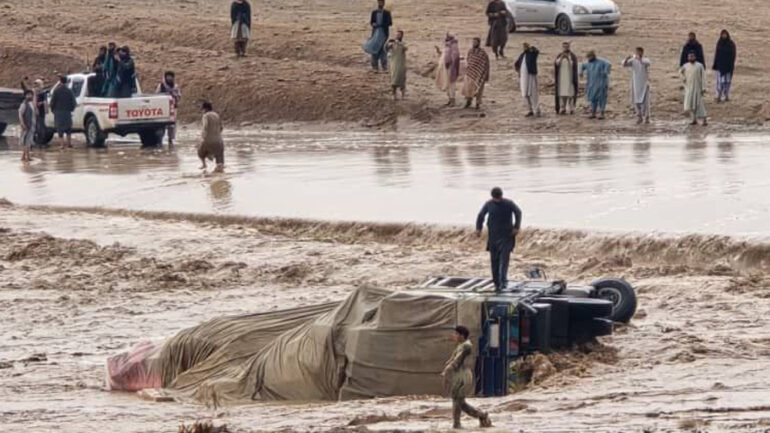

KABUL, AFGHANISTAN – Heavy rainfall and flooding across several provinces in Afghanistan over the past 24 hours killed at least five people and injured six others, according to the Taliban-run National Disaster Management Authority.
In an audio message shared on social media, Mohammad Yousuf Hammad, spokesperson for the authority, said the provinces most affected included Parwan, Paktia, Kandahar, Zabul, and Helmand.
According to Hammad, at least 16 homes were completely destroyed, while 87 others were partially damaged. Three families have been displaced, and a total of 180 families were affected by the flooding. Many households have lost belongings and livestock, worsening existing economic hardships.
Separately, the Taliban-run Radio and Television of Afghanistan reported that the roof of a house collapsed due to heavy rain in Sangin district of Helmand province, killing three people, including two children, and injuring six others.
Heavy rains have hit large parts of Afghanistan over the past day, particularly southern and eastern provinces. In addition to causing human casualties, the flooding has severely impacted livestock, farmland, and livelihoods, further straining an already fragile economy.
These are the latest reported civilian casualties from seasonal rainfall. Earlier this year, rainfall and flooding killed at least 12 people and injured 11 others across 11 provinces. Before that, heavy snow and rain reportedly killed 61 people and injured over 110, causing widespread damage to roads, homes, and public infrastructure.
Afghanistan remains highly vulnerable to seasonal snow, rain, floods, and landslides, particularly in rural areas where infrastructure is weak and many homes are not built to withstand extreme weather. Experts say climate change is making rainfall and storms more intense and unpredictable, increasing the severity and frequency of such incidents, and placing additional strain on the country’s fragile economy and limited disaster response capacity.

