


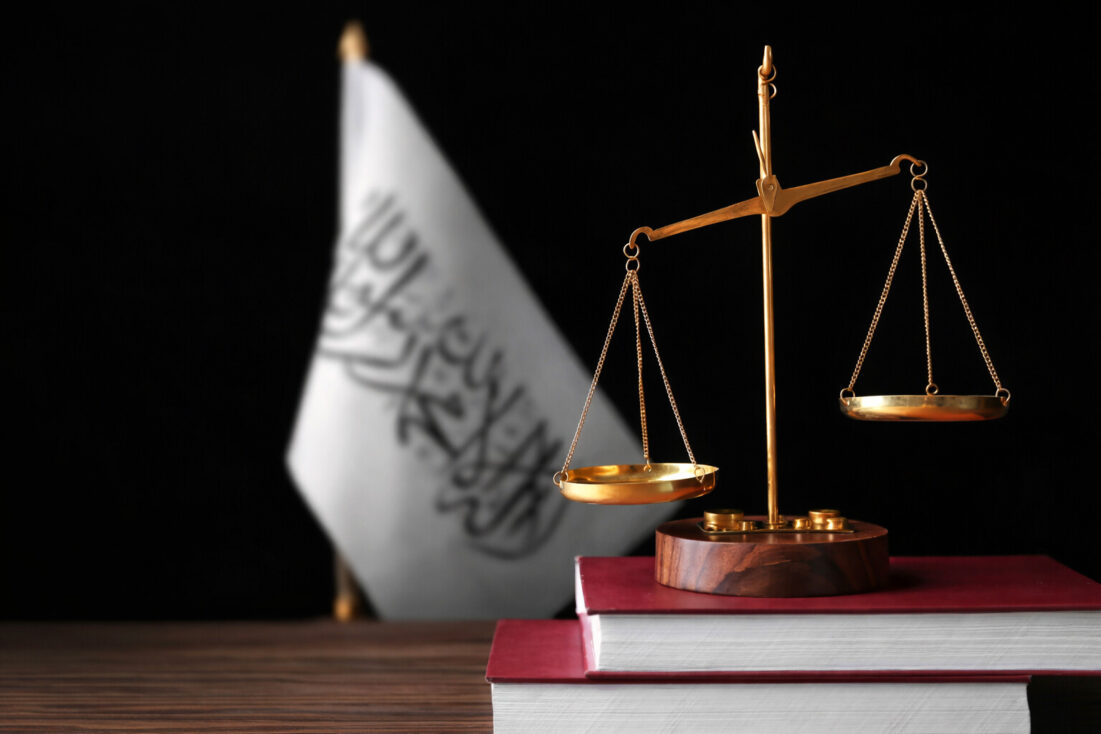
After nearly four years of legal ambiguity and the absence of a declared and transparent legal framework under Taliban rule, the group has recently published a Pashto-language document titled ‘Principles for Criminal Courts,’ which it presents as a basis for criminal justice. This document, organized into an introduction, three chapters, ten sections, and 119 articles, is introduced as the basis for defining crimes, prosecuting offenses, and determining punishments within the Taliban’s judicial structure. The publication of this principles document has from the outset provoked widespread reactions among legal scholars, human rights defenders, civil institutions, and security experts, raising serious concerns about the future of criminal justice and social security in Afghanistan.
Several Afghan legal and political figures have criticized the document. Fazl Ahmad Manawi, the former Minister of Justice of Afghanistan, described it as a mockery of Islam in public remarks. The Afghanistan Freedom Front (AFF), an armed opposition group to the Taliban, called the document a historical regression for Afghanistan. Some experts have stated that the implementation of this Taliban legal document will cause dangerous consequences for Afghan society. Meanwhile, Nasrullah Stanikzai, a former law professor at Kabul University, considers this principles document to be in opposition to international criminal laws, conventions, and universal declarations.
In a public statement, the human rights organization Rawadari, warned that the document “is deeply concerning and in clear conflict with international human rights standards and the fundamental principles of a fair trial.” According to the statement, the document formalizes discrimination against religious minorities and institutionalizes the suppression of fundamental freedoms, including violations of human dignity, freedom of expression and thought, as well as arbitrary detention and punishment.
From a legal perspective, the document raises fundamental questions of legitimacy. In modern legal systems, penal codes are typically the result of transparent legislative processes grounded in public representation. The Taliban’s ‘Principles for Criminal Courts’ did not pass through any elected body, nor does it provide mechanisms for public review, amendment, or oversight. Instead, it is the product of the views and rulings of a limited circle of Taliban members, particularly the office of Mullah Hibatullah’s advisors in Kandahar (who are known as the Sheikhs). Such a situation undermines the fundamental principle of the rule of law and transforms the law into an instrument in the hands of the ruling power.
The second legal challenge is the violation of fair trial principles. The document makes no clear provision for fundamental fair-trial guarantees, including the right to legal counsel, the presumption of innocence, the right to remain silent, public hearings, or effective appeal mechanisms. Weakening these principles increases the risk of arbitrary and discretionary verdicts and erodes public trust in the judicial system—a matter that directly leads to security consequences.
From the perspective of legal security, the implementation of a harsh and ambiguous Principles for Criminal Courts, without clear distinctions between crimes, punishments, and the jurisdictions of courts, can lead to the widespread criminalization of social behaviours. This situation places citizens under constant threat of prosecution and punishment and intensifies the sense of legal insecurity in society. Evidence shows that over the past four years, the Taliban have continuously used legal ambiguity as one of their tools for collective control.
On the other hand, the concentration of judicial power in the hands of a non-accountable and legally illegitimate structure can turn the Principles for Criminal Courts into a tool for political and social repression. Under such conditions, the line between criminal offense and civil dissent becomes blurred, and any form of protest, criticism, or different behaviour can be prosecuted under criminal charges. This not only tightens the public space further but also paves the way for the arbitrary actions of regime affiliates and the widespread suppression of the people.
The Content and Provisions of the Law
An examination of the content of this law clearly shows that none of the human rights values, particularly those rooted in Afghanistan society have been considered. This text presents only a harsh and radical narrative, the implementation of which will lead to collective suppression, widespread human rights violations, and ultimately, the relegation of Afghanistan society to a quasi-medieval state in legal terms.
The introduction of this law is organized into three articles. Article one defines the meaning of principles and laws as documents and laws that have been approved and signed by Hibatullah, the leader of the Taliban. In reality, any law or document that does not bear Hibatullah’s approval is declared null and void. Article Two defines twenty terms used in this law, examples of which are as follows:
- Durah (a type of whip/lash): Refers to the instrument by which a judge carries out a hadd (حد) punishment.
- Mubtadi’ (Innovator/Bid’ah adherent): Someone who holds a belief contrary to the creed of Ahl al-Sunnah wal-Jama’ah.
- Accused (Mutaham): Someone who has committed the crimes listed in this principles document and against whom just witnesses have testified before a judge.
- Criminal (Mujrim): Someone who has been sentenced to punishment by a court for committing crimes listed in this principles document.
By examining just these four items, it can be understood that the content of this principles document is very ambiguous, general, and open to broad interpretation. For example, in the definition of “Durah,” the type of punishment instrument is entirely left to the judge’s discretion. Accordingly, the judge can use any instrument they wish and have at their disposal to carry out the hadd punishment. In the definition of “Mubtadi’,” it includes all individuals who are not followers of the Ahl al-Sunnah creed. No distinction is made between followers of other Islamic schools of thought and non-Muslims; all are labelled as “innovators.”
Also, in this principles document, an individual in the eyes of the Taliban is either “Accused” or “Criminal”; the concept of “Suspect” does not exist in the Taliban’s penal system. Under the definitions provided, an individual may be designated as an ‘accused’ based on the testimony of a ‘just’ witness, a term that the document does not define. The text does not reference forensic evidence, medical examinations, or modern investigative standards. At the same time, trial stages are not mentioned, and merely the verdict of the courts (even at the primary level) is set as the criterion for deeming someone a criminal. Taliban courts are single-tier, and there is no avenue for appealing issued verdicts.
The first chapter of this principles document is written in three sections concerning the principles for implementing Ta’zir (discretionary) punishment, its levels and types, those deserving it, and related rulings.
In this chapter and other parts of the document, the term “Imam” with extensive authority is repeatedly mentioned, but neither in the definitions section nor in the text is a definition of “Imam” provided. It is unclear who is meant by “Imam” in this document. Is the judge called Imam, or is Mullah Hibatullah? While in some parts of this document, both the judge and Mullah Hibatullah are referred to, the latter as the “Commander of the Faithful” for the group. For example, in Clause One of Article Four, the determination of Ta’zir punishment is delegated to the opinion of the Imam. In Clause Five of the same article, Hadd punishment is associated with the opinion of the Imam, and Ta’zir punishment is also considered within the husband’s jurisdiction.
On the other hand in Clause Six of this article, the implementation of Ta’zir punishment in cases of flagrant crime is considered within the jurisdiction of any Muslim and introduced as a type of “Prevention of vice.”
In just this one article, serious contradictions emerge regarding who is authorized to impose and carry out Ta’zir punishment. The document repeatedly assigns broad punitive authority to an undefined “Imam,” creating ambiguity over whether this role refers to judges, religious figures, or Taliban leadership. In some clauses, this authority appears to extend beyond formal judicial actors, raising the risk of arbitrary enforcement.
In Section Two of this chapter, a very important topic contrary to all contemporary legal and human rights norms is addressed. In this section, individuals are divided into multiple ranks or layers, each layer having different privileges and exemptions from Ta’zir punishment:
- In Clause One of Article Nine, for the Ta’zir punishment of scholars and high-ranking individuals, only the “recommendation” of the judge is considered sufficient, and this class is not introduced as deserving more severe punishment.
- In Clause Two, regarding the Ta’zir punishment of nobles, tribal elders, and merchants, “summoning them to court and recommending” is deemed sufficient.
- In Clause Three, the middle social class is deemed deserving of imprisonment.
- In Clause Four, the punishment for the lower class of society is anticipated as “threatening, beating, and striking with Durah.”
Article 9 introduces differentiated punishments based on social status, contradicting the principle of equality before the law. The categories—such as ‘scholars,’ ‘nobles,’ and ‘lower class’—are not defined, leaving their interpretation to judicial discretion.
Furthermore, like other articles of this law, it is very ambiguous and open to interpretation. The law provides no definition for “scholars,” “high-ranking individuals,” “nobles,” “tribal elders,” “merchant,” “middle class,” and “lower class of society.” The judge and the Taliban regime apparatus have the authority to identify these individuals based on their own understanding and determine their punishments. In practice, these categories are likely to encompass individuals aligned with or supportive of the Taliban, granting them de facto immunity from punishment.
One of the most concerning articles of this law is Article 14 titled “Penalty of Killing for Public Interest.” This article authorizes the death penalty in cases deemed necessary for ‘public interest,’ a term left undefined. In related provisions addressing moral offenses, the document prescribes capital punishment for what it describes as habitual sodomy and other acts deemed corrupting, raising serious concerns about the safety of LGBTQ+ individuals and other marginalized groups.
Also, in this article, individuals who defend beliefs contrary to Islam or invite others to false beliefs (which according to this law includes “Mubtadi'”) are considered deserving of the death penalty. As mentioned earlier, “Mubtadi'” refers to those who have a religious belief other than the Ahl al-Sunnah creed. Accordingly, any religious ceremony of Shiites (Ja’fari and Ismaili) and Hindus residing in Afghanistan is a crime, and its practitioners are deserving of the death penalty.
In Section Three of this principles document, a range of broadly defined and ambiguous acts are designated as crimes, and explicit reference is made to the category of “slave” or “captive.” This language signals a return to legal concepts associated with slavery in Afghanistan after nearly a century of formal prohibition. Slavery was officially outlawed under Article Ten of the Constitution during the reign of King Amanullah Khan and remained prohibited until the Taliban’s return to power. The reappearance of such concepts within a contemporary legal framework raises serious concerns about the erosion of long-standing legal and moral safeguards against enslavement.
Also, in this section, any form of insult and mockery of the Prophet of Islam (PBUH), other prophets, and religious holidays is considered a crime, and its perpetrator is deemed deserving of the death penalty or imprisonment.
In Article 24 of this principles document, all citizens of Afghanistan are obligated to spy for the Taliban regime, and it is stipulated that if someone becomes aware of gatherings and activities of groups opposing the Taliban but does not inform Taliban authorities, they have committed a crime and two years of imprisonment is anticipated for them. Since in this law the concept of “opponent” is very broadly defined, this article gives Taliban members a pretext to accuse and punish many individuals.
In Article 26, apostasy from the Hanafi school of thought is criminalized, and someone who converts from this school is sentenced to two years in prison. While in other documents of the Taliban regime, it is seen that in Badakhshan province, followers of the Shiite-Ismaili school are encouraged or even forced to convert to Hanafism. Based on this article, only the Hanafi School is considered the true version of Islam, and other schools are outside this circle. This topic is in complete contradiction with the social, historical values and peaceful coexistence of Afghanistan citizens with different religious beliefs.
In Article 27, any form of propagation and teaching of religious beliefs other than Ahl al-Sunnah wal-Jama’ah is prohibited as “innovation,” and individuals performing it are sentenced to ten years in prison. Accordingly, all religious activities of followers of other schools of thought are considered crimes. This action even contradicts the explicit command of the Quran (Surah Al-Baqarah, verse 256) which rejects compulsion in religion and also violates human rights principles in the field of freedom of belief.
In Article 30 of this document, corporal punishment of students in schools and religious madrassas is permitted to an extent, and only if the teacher inflicts such beating that breaks the student’s bone, the teacher will merely be dismissed from duty. In other cases, any amount of beating is permitted. This article also contradicts human dignity and violates children’s rights.
In this law, women’s rights are repeatedly disregarded, and women are practically reduced to slaves of their husbands. In Article 32, beating a wife by her husband is permitted, and only if it causes bone fracture, severe injury, or extensive bruising on the woman’s body and the woman can prove it before a judge, the husband is merely sentenced to 15 days in prison (based on the judge’s discretion). In practice, proving this by the victim herself (the woman) and also before a Taliban judge who requires the testimony of at least two just witnesses is difficult and even impossible.
In Article 34, even a woman going to her father’s house without her husband’s permission is criminalized, and not only the woman but also her father are deemed deserving of up to three months in prison. This article practically sentences women to permanent confinement in the husband’s house and has turned them into slaves who can even go to their father’s house only with their husband’s permission.
In another provision, Article 39 criminalizes greeting a female neighbour, and two months in prison is anticipated for the perpetrator. This is while based on the culture of the Afghanistan people, especially in urban areas and settlements of Hazara, Tajik, and Uzbek ethnicities, greeting neighbours is a commendable custom. This topic, like other cases, is not contingent upon a complaint and in fact gives Taliban members and “any other Muslim” (as mentioned earlier) the authority to intervene and punish individuals.
In Article 41, breaking the fast during the month of Ramadan is criminalized, and an individual who does not fast during this month is introduced as deserving two months in prison and 20 strikes of “Durah.” This article can create serious challenges for some Afghanistan citizens during its implementation and conflicts with religious injunctions, especially in the Shiite school. Based on Shiite jurisprudence, fasting is not obligatory for travellers, a mother with a nursing infant (under specific conditions), etc. In such cases, the Taliban, by ignoring this religious ruling, will exert great pressure on Shiites under the pretext of breaking the fast.
In contrast, based on Clause Two of Article 45, the punishment for someone who murders another person with poison is only five years in prison. While in Islam, retribution (Qisas) is prescribed for premeditated murder, the Taliban leader has acted contrary to verses 178 and 179 of Surah Al-Baqarah and verse 45 of Surah Al-Ma’idah which clearly rules on retribution.
The Taliban have also disregarded the cultural and artistic values of the Afghanistan people in this law, and based on Article 59, any form of dance and watching it is criminalized, and the perpetrator will face up to two months in prison. This is while in the culture of all ethnicities residing in Afghanistan, dance is performed as an inseparable part in various ways. Even in the culture of the ethnicity to which the Taliban leader belongs, dance (in the form of Atan) is considered one of the cultural programs of the people.
Under its Penal Code, the Taliban allow the issuance of “licenses” for narcotics-related activities but fail to explain what these licenses are, how they are granted, or when such activities are allowed. Article 114 exempts individuals from punishment if they grow, transport, or produce narcotics under an official Taliban-issued license. The lack of clear rules raises concerns that the law could be applied selectively. In practice, this approach may open the door to abuse and allow the Taliban and their associates to control and monopolize the narcotics trade under a legal cover.
Sources Cited in This Law
The Taliban’s Principles for Criminal Courts generally refers to various sources of Hanafi religious texts, which include dozens of titles from old jurisprudential books, mostly belonging to past centuries and written by scholars outside Afghanistan. Titles such as:
Al-Binayah Sharh al-Hidayah, Sahih al-Bukhari, Al-Fatawa Tanqih al-Hamidiyah, Sharh al-Kasir al-Kabir, Al-Durr al-Mukhtar and Hashiyat Ibn Abidin, Hashiyat Radd al-Muhtar ala al-Durr al-Mukhtar, Al-Bahr al-Ra’iq Sharh Kanz al-Daqa’iq, Majallat al-Ahkam, Al-Mahsul lil-Razi, Marqat al-Mafatih Sharh Mishkat al-Masabih, Taysir al-Tahrir li-Amir Badshah, Al-Mu’jam al-Wasit, Mu’jam al-Mustalahat wa al-Alfaz al-Fiqhiyah, Al-Qamus al-Fiqhi, Hujjat al-Balaghah lil-Dahlawi, Izaalat al-Khafa, Radd al-Muhtar, Al-Fatawa al-Hindiyah, Al-Tatarkhaniyah, ‘Umdat al-Ri’ayah, Al-Fiqh al-Hanafi fi Thawbih al-Jadid, Al-Bahr al-Ra’iq, Mu’in al-Qudah al-Muftin, Ghumz ‘Uyun al-Basa’ir fi Sharh al-Ashbah wa al-Naza’ir, Bada’i’ al-Sana’i’, Al-Tashrih al-Jina’i, Durar al-Ahkam fi Sharh Majallat al-Ahkam, Tabayyun al-Haqa’iq, Al-Mabsut lil-Sarakhsi, Rasa’il Ibn Nujaym al-Iqtisadiyah, Fatawa al-Hudud wa al-Ta’zirat lil-Muftin wa al-Quda, Minhaj al-Sunan, Nisab al-Ihtisab, Al-Tashri’ al-Jina’i al-Islami, Al-Fatawa al-Anqarawiyah, Al-‘Inayah ‘ala Fath al-Qadir, Ahkam al-Aradi li-Muhammad Ali al-Tahanawi, Al-Fiqh al-Hanafi fi Thawbih al-Jadid, Fatawa Matanah, Fatawa al-As’adiyah, Al-Fiqh ‘ala al-Madhahib al-Arba’ah, Hujjat al-Balaghah, Al-Mawsu’ah al-Jina’iyah fi al-Fiqh al-Islami, Al-Tashri’ al-Jina’i al-Islami li-‘Awdah, Al-‘Uqubah fi al-Fiqh al-Islami li-Abi Zahrah, Jami’ al-Rumuz, Al-Madkhal al-Fiqhi al-‘Am lil-Zarqa, Al-Fatawa al-Tamartashi, Adab al-Qada lil-Saruji, Al-Asl lil-Shaybani, Al-Natf fi al-Fatawa lil-Sughdi and several other similar cases.
By including this long list, the Taliban have tried to claim that the content of this principles document is based on Islamic guidance and that Mullah Hibatullah has not written anything beyond it. While clear examples of this law’s contradiction with the Quranic text were provided earlier. Using seemingly religious sources is one of the Taliban’s main tactics for legitimizing their own behaviours. With this approach, they confront people with a distorted narrative in the name of religion, blocking the path of protest and facilitating repression.
But what are the security consequences of this law for the people of Afghanistan and the world?
Abundant evidence shows that the Taliban’s approach towards the people of Afghanistan and the international community has always been hostile, vindictive, and destructive. Reliable reports indicate that by harbouring terrorist groups on Afghan soil and supporting them, the Taliban have challenged regional security. On the domestic front, the widespread suppression of the Afghan people, especially women and intellectuals, has become a daily strategy, the result of which has been the deprivation of millions of women from education, public services, and the most basic human rights, as well as the detention, torture, and killing of hundreds of former Afghanistan national defence and security force (ANDSF) in the Taliban’s revenge process.
The publication and implementation of this law gives the Taliban this superficial legitimacy to carry out what they have been doing over the past four years in a legal vacuum, now with the pretext of law and the public order of their leader. This law, which is broadly interpretable, ambiguous, and in conflict with human, human rights, Islamic, and cultural values of the Afghanistan people, has been drafted within a very limited circle of individuals with an extremely extremist mindset opposed to any pluralism, and has turned conditions into an even more suffocating space for the people of Afghanistan.
In this law, the Taliban have defined their opponents under ambiguous titles such as rebel, apostate, combatant, thief, corruptor, and innovator, deeming them deserving of imprisonment and the death penalty. This topic, as mentioned, is very broad and at the same time ambiguous, giving Taliban members the opportunity to punish anyone they wish under these titles.
At the same time, all Muslims are obligated that if they observe acts criminalized in this law, they must take action and consider it part of the responsibility of “Prevention of vice.” This means anyone can be a judge, police officer, and jailer. Anyone can punish another under the pretext of committing a crime, and a vicious cycle of personal vendettas in society gains legal and religious sanction.
Another important concern is that through this law, the Taliban have deemed followers of other schools of thought (other than Ahl al-Sunnah wal-Jama’ah) as innovators deserving severe punishments. While in Afghanistan, besides Ahl al-Sunnah, Shiites and also followers of the Hindu and Sikh faiths live. Since many Taliban members are illiterate and harbour resentment towards the Afghanistan people due to their support for democracy and human rights over the past two decades, they will have a freer hand to suppress followers of other faiths. Among these, Shiites and especially the Hazaras, as symbols of Shiism in Afghanistan, will suffer the most.
Classifying individuals before the law and punishment is very ambiguous and contrary to the principle of equality of rights for all, and even opposed to verse 13 of Surah Al-Hujurat which emphasizes the equality of humans and considers the most honourable among them the most pious. At the top of these exemptions are “scholars and high-ranking individuals,” who mainly include members and intellectual supporters of the Taliban. In the next stage, “nobles and tribal elders” are also generally collaborators and supporters of this group. The other two groups, especially the fourth group (lower class), are ordinary Afghan people who constitute the absolute majority and have no affiliation with the Taliban. Accordingly, this vast segment of society becomes the primary target of punishment and suppression. This will cause nearly the entire population of Afghanistan to live in fear and under constant surveillance by the Taliban regime.
Women’s vulnerability has been intensified and legitimized by this law. This law has legally transformed women into slaves under men’s control, and there is no real path or authority for them to claim their rights and secure justice for the oppression inflicted upon them. Even a woman going to her father’s house has been criminalized. This situation completely destroys women’s psychological and physical security and will fuel increased violence, suicide, honour killings, and similar cases.
In practical terms, the reintroduction of these concepts, alongside systematic human rights violations and practices that undermine human dignity, creates conditions in which economically marginalized individuals may once again be vulnerable to enslavement by powerful or regime-affiliated actors. This development reopens deep historical wounds for the Hazara people—a community for whom enslavement was a lived reality for many years prior to Amanullah Khan’s reforms, particularly during the reign of Abdur Rahman Khan, when large numbers endured severe oppression, including slavery.
Finally, the suppression of individuals and social groups opposing the Taliban narrative has now become structured and codified. The Taliban now have a codified and published legal license for their oppression and suppression. This law not only confronts the internal stability and security of Afghanistan with an unprecedented threat but, by legitimizing extremism, systematic discrimination, and flagrant human rights violations, creates serious concerns for regional security and human rights at the global level.

