

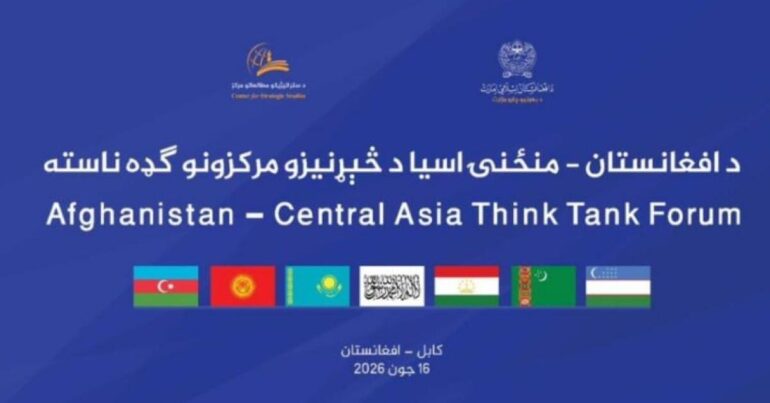

KABUL, AFGHANISTAN – The Taliban will host a regional meeting in Kabul on Tuesday, bringing together representatives from Central Asian countries and Azerbaijan to discuss regional connectivity and economic cooperation.
The event, titled the “Afghanistan–Central Asia Think Tank Forum,” will be hosted by the Strategic Studies Center under the Taliban’s foreign ministry, according to Taliban-run Radio and Television of Afghanistan (RTA).
Officials and experts from leading research institutions across Central Asia and Azerbaijan are expected to attend. The Taliban said the forum aims to promote dialogue between policy and research communities on regional issues.
According to RTA, discussions will focus on regional connectivity, stability, trade, energy, transit, investment, and broader economic cooperation. The meeting will also review existing engagement between Afghanistan and Central Asian states and explore proposals described as “practical, implementable, and result-oriented.”
The meeting comes as the Taliban continue to deepen diplomatic and economic ties with neighboring Central Asian countries, including on trade routes and infrastructure projects. Since returning to power in 2021, the group has held a series of bilateral and multilateral meetings with regional governments.
However, none of the Central Asian countries or Azerbaijan has formally recognized the Taliban administration. Many remain concerned about the expanding activities of militant groups within Afghanistan.
Afghanistan’s geographic position at the crossroads of Central and South Asia makes it a strategically significant hub for regional connectivity, offering potential routes for major trade and energy corridors linking landlocked Central Asian countries to international markets.
Projects such as transnational railways, gas pipelines, and electricity transmission lines depend heavily on stability and cooperation in Afghanistan, underscoring the country’s importance in facilitating economic integration, reducing transit costs, and enhancing regional interdependence.

