

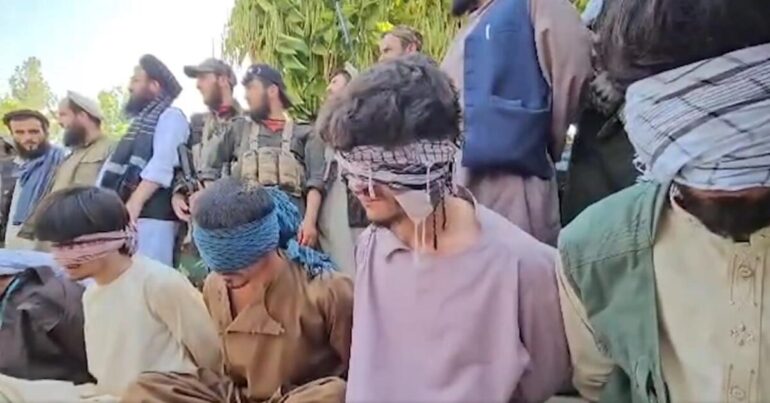

KABUL, AFGHANISTAN – Former Afghan lawmaker Fawzia Koofi has accused the Taliban of detaining civilians, including children, following clashes in Yaftal district of Badakhshan province, where the anti-Taliban Homeland Front (Sepahiyan-e Mihan) briefly seized the district center.
In a post on X, Koofi shared a video showing several young men in Taliban custody and alleged that the group had begun arresting civilians on the assumption that they were connected to the assault on Yaftal district earlier on Friday.
She said the Taliban were using the arrest and repression of ordinary people as a tool of pressure and warned that “the more they suppress the people, the stronger the desire and determination for freedom will become.”
Earlier on Friday, local sources reported that a newly established armed opposition group calling itself “Sepahian-e Mihan” (Soldiers of the Homeland) launched a surprise attack on Yaftal-e Payeen district, targeting the district administration headquarters, police command, and Taliban intelligence offices.
According to the sources, the group succeeded in taking control of the district center for several hours. Videos and photographs circulated on social media appeared to show a blue flag flying over the district administration compound in place of the Taliban flag, while footage from the area contained sounds of gunfire and clashes.
A source familiar with the matter identified the group’s commander as Abdul Qayum Malang, a former member of Afghanistan’s special forces under the previous Western-backed government.
Following the attack, Taliban Chief of Army Staff Fasihuddin Fitrat traveled to Yaftal-e Payeen to assess the situation. Speaking to reporters at the district police headquarters, Fitrat called the assailants “troublemakers” who sought to “stand against the system” but failed to achieve their objectives.
The Taliban have claimed they arrested several individuals involved in the attack. In a video circulated by Taliban-affiliated sources, several young men in civilian clothing said they had been “deceived” into participating in the assault before being detained. The circumstances under which the video was recorded could not be independently verified.
However, the Homeland Front rejected the Taliban’s claim, insisting that none of its fighters had been captured. Koofi also disputed the Taliban’s account, alleging that those detained were civilians with no involvement in the attack.
The fighting has drawn reactions from several former Afghan officials.
Former Afghan Attorney General Mohammad Farid Hamidi described the temporary capture of Yaftal district as a symbolic blow to what he called the Taliban’s narrative of invincibility and nationwide control.
In a statement posted on X, he argued that the operation demonstrated that political and ethnic monopolization of power, discrimination, authoritarian rule, and governance through force cannot endure.
Hamidi also said the attack illustrated that armed resistance could be conducted within legal and ethical principles, arguing that, unlike many previous conflicts in Afghanistan, the operation focused on military targets rather than causing civilian casualties or destroying public infrastructure.
He added that the incident underscored the unsustainability of what he described as the Taliban’s “oppressive, illegitimate, and discriminatory rule,” while stressing that Afghanistan’s long-term stability depends on dialogue, social justice, equality, an end to discrimination, respect for the dignity of women and men, and equal citizenship.
Nasir Ahmad Andisha, Afghanistan’s representative to the UN Human Rights Council, also voiced support for the offensive.
In a post on X, he described the attack as “Today’s cry is the cry to break the silence in the face of tyranny” and said that “once again from the heart of the Hindu Kush and from the land of the fighters, the voice of resistance is heard.”
Andisha said the developments in Badakhshan demonstrated that “oppression and enslavement will not take root in this soil.” Without explicitly naming the Homeland Front, he said history would remember those making sacrifices against injustice.
He also criticized engagement with the Taliban, describing support for the group as a betrayal of dignity and arguing that hopes for compromise with the Taliban amounted to false expectations.
The clashes in Yaftal mark one of the most significant anti-Taliban operations in recent months, as armed resistance groups continue to challenge Taliban rule in parts of northern Afghanistan, despite the group’s continued control over most of the country.
The incident comes as Badakhshan, a mountainous province bordering Tajikistan, China, and Pakistan, has emerged as one of Afghanistan’s most volatile regions in recent years. In addition to sporadic attacks claimed by anti-Taliban groups, the province has experienced local unrest, disputes between Taliban commanders, and conflicts over control of mines and other revenue sources, including drug-related activities.
The Taliban maintains that no organized armed opposition poses a serious challenge to its authority. However, several groups, including the National Resistance Front and the Afghanistan Freedom Front, continue to carry out guerrilla attacks against Taliban forces in different parts of the country.

