

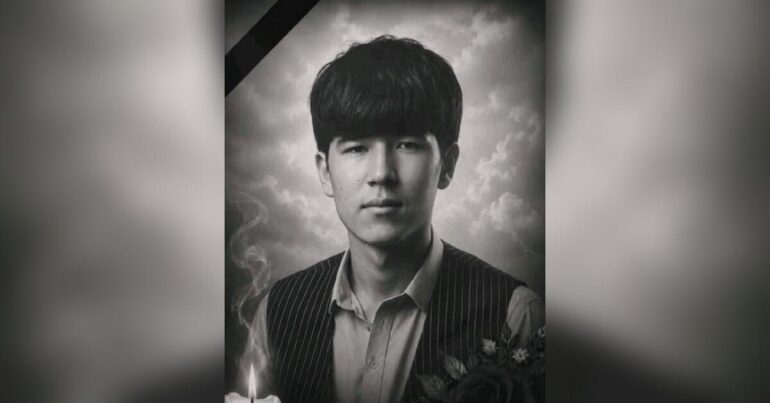

KABUL, AFGHANISTAN – Local sources in Herat say that the body of Morteza Karimi, one of the people injured during the recent public protests in the Jebrail area of Herat who died last night, was buried today (Tuesday, June 16) in the “Kamar-e Kalagh” area of Herat under heavy surveillance by Taliban intelligence agents.
According to the sources, the Taliban did not allow a public funeral procession for Morteza, and one vehicle and five motorcycles belonging to Taliban intelligence monitored the transfer of the body to the cemetery.
According to reports from the sources, the Taliban also did not allow Morteza’s family to use the word “martyr” (Shahid) for him and prevented the installation of a sign that read “Martyr Morteza Karimi.”
Sources say that Morteza Karimi’s family is under intense pressure from Taliban intelligence and that two Taliban intelligence members are constantly stationed outside his home.
According to the sources, due to the heavy pressure from Taliban intelligence, it remains unclear at what scale, how, and in which mosque a memorial service for Morteza Karimi will be held.
Alleged Neglect During Medical Treatment
Morteza Karimi was injured last Tuesday during the Taliban’s suppression of protests by residents of Jebrail, Herat. Before his death, he spent seven days in Herat Provincial Hospital.
Sources say that during the protests, a Taliban member shot Morteza twice; one bullet struck the kneecap of his right leg, and the other hit an area below his left knee.
According to the sources, after Morteza was wounded, his friends took him to Quds Hospital and then to Hakim Sanai Hospital, but both hospitals refused to admit him, saying that the Taliban had not allowed them to treat the wounded protesters.
According to the information provided by the sources, Morteza’s friends then transported him by a three-wheeled vehicle to the intensive care unit (ICU) of Herat Provincial Hospital. However, by the time he arrived there, he had lost a significant amount of blood and had fallen unconscious.
Sources say that doctors at Herat Provincial Hospital were also “negligent” toward Morteza’s condition, which caused the bleeding to worsen and led to kidney failure.
According to the sources, during the seven days Morteza was hospitalized in the ICU, whenever he regained consciousness he underwent dialysis, and when he lost consciousness he was returned to intensive care.
According to the sources’ claims, the Taliban’s prevention of treatment for wounded protesters at hospitals in the Jebrail area, combined with the alleged “negligence” of doctors at Herat Provincial Hospital, caused Morteza’s kidneys to completely fail, ultimately leading to his death last night (Monday, June 15).
Sources say that despite severe economic hardship, Morteza’s family covered all medical expenses themselves and received no assistance.
The death of Morteza Karimi followed an initial demonstration on June 9 in Herat’s predominantly Hazara-populated Jibrail Neighbourhood, which erupted after days of mounting public anger over the detention of women. During that protest, Taliban forces reportedly opened fire directly on the crowd and beat demonstrators, killing at least one child and injuring around 20 others, according to local sources and videos.
Following the first protest, the Taliban deployed hundreds of armed fighters equipped with light weapons, rockets, and tanks across Herat and set up multiple checkpoints on major routes. Similar security measures were implemented in Kabul’s Dasht-e-Barchi, a Hazara-populated neighbourhood in western Kabul, where large numbers of troops and military vehicles were positioned to head off potential unrest. No protests were reported in Kabul as of Friday evening.
The Taliban’s use of force against peaceful demonstrators and the detention of women and girls have also drawn strong international condemnation. The United Nations, human rights organizations, politicians, and citizens worldwide have called on the group to stop the violence against peaceful protesters and immediately release all detained women and girls.
Since returning to power in 2021, the Taliban have imposed sweeping restrictions on women’s education, employment, movement, and participation in public life. Activists argue that continued international pressure and sustained global attention are essential to preventing further erosion of women’s rights and ensuring that the voices of Afghan women remain at the center of discussions about Afghanistan’s future.

