

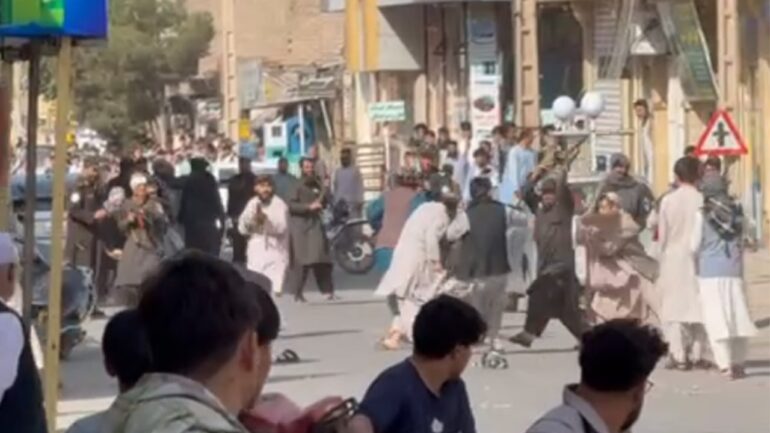

KABUL, AFGHANISTAN – Members of the Afghan diaspora in Canada, Germany, and France have staged protests in support of women and demonstrators in Herat, condemning the recent detention of women and girls by the Taliban and calling for greater international action to protect women’s rights in Afghanistan.
In Canada, protesters gathered outside the University of Toronto and Queen’s Park, chanting slogans such as “Education, Work, Freedom” and “Freedom for Afghanistan.” Demonstrators called on the international community to stand with Afghan women and girls and denounced the Taliban’s restrictions on women as a form of “gender apartheid.”
Similar demonstrations took place in Germany, where Afghan migrants expressed solidarity with women and protesters in Herat. Participants echoed the slogan “Education, Work, Freedom” and demanded the restoration of fundamental rights and civil liberties for Afghan women and girls.
Meanwhile, Afghan activists and community members in Paris organized a protest in response to reports of arrests and abductions of women and girls in Herat.
In a statement released during the gathering, protesters said that girls in Afghanistan are being denied access to education solely because of their gender, while women are deprived of basic freedoms, including the rights to work, move freely, and participate in public life.
The demonstrators said recent reports of women being detained in Herat reflect an escalation of pressure and intimidation against women. They argued that these incidents are not isolated cases but part of a broader and systematic effort to remove women from public life and impose increasingly severe restrictions on their freedoms.
The statement further described the situation in Afghanistan as more than a series of social restrictions, characterizing it as a system built on repression, exclusion, and what protesters referred to as “gender apartheid.”
Participants also expressed concern over the inclusion of Taliban representatives in international forums without meaningful accountability for human rights violations. They warned that engaging with the Taliban without addressing their treatment of women could contribute to the normalization and legitimization of ongoing abuses.
They stressed that silence in the face of the current situation in Afghanistan should not be viewed as neutrality, but rather as a failure to confront injustice and the continued suppression of women.
The wave of solidarity protests also extended to Iran, where a number of Afghan women gathered outside the Taliban embassy in Tehran to condemn the detention of women and girls and the crackdown on protesters in Herat. Demonstrators denounced the Taliban’s actions and called for an end to the repression of women across Afghanistan.
At the same time, a group of Afghan women in Mashhad attempted to organize a protest outside the Taliban consulate. However, Iranian police reportedly prevented the demonstration from taking place. The General Directorate for Foreign Nationals Affairs of Razavi Khorasan Province had previously warned that Afghan migrants are not permitted to hold public protests without authorization from the Iranian government.
The demonstrations in Iran, alongside those held in Canada, Germany, and France, highlight the growing mobilization of Afghan diaspora communities in response to the treatment of women under Taliban rule.
The latest protests followed an initial demonstration on June 9 in Herat’s predominantly Hazara-populated Jibrail Neighbourhood, which erupted after days of mounting public anger over the detention of women. During that protest, Taliban forces reportedly opened fire directly on the crowd and beat demonstrators, killing at least one child and injuring around 20 others, according to local sources and videos.
Following the first protest, the Taliban deployed hundreds of armed fighters equipped with light weapons, rockets, and tanks across Herat and set up multiple checkpoints on major routes. Similar security measures were implemented in Kabul’s Dasht-e-Barchi, a Hazara-populated neighbourhood in western Kabul, where large numbers of troops and military vehicles were positioned to head off potential unrest. No protests were reported in Kabul as of Friday evening.
The Taliban’s use of force against peaceful demonstrators and the detention of women and girls have also drawn strong international condemnation. The United Nations, human rights organizations, politicians, and citizens worldwide have called on the group to stop the violence against peaceful protesters and immediately release all detained women and girls.
Since returning to power in 2021, the Taliban have imposed sweeping restrictions on women’s education, employment, movement, and participation in public life. Activists argue that continued international pressure and sustained global attention are essential to preventing further erosion of women’s rights and ensuring that the voices of Afghan women remain at the center of discussions about Afghanistan’s future.

