

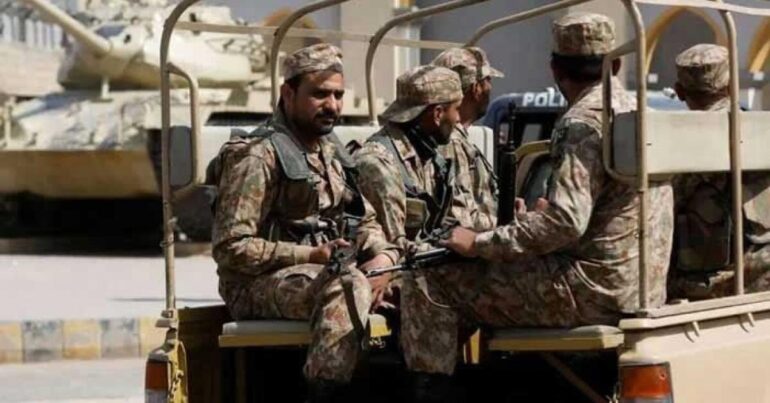

KABUL, AFGHANISTAN – Pakistan’s military says that since July 5 of this month, at least 79 “terrorists” have been killed in operations carried out by the country’s security forces in Balochistan.
In a statement released by the Pakistan Army on (Friday, July 10), it said that 43 “terrorists” were killed in “Operation Shaban” alone.
The Pakistani military identified the individuals as members of “Fitna al-Khawarij” and “Fitna-e-Hindustan,” terms Islamabad uses to refer to the Tehrik-i-Taliban Pakistan (TTP) and the Baloch Liberation Army (BLA), respectively.
The military said that Operation Shaban was launched following an attack on a police checkpoint in the Mangi area of Balochistan and is being carried out jointly by the Pakistan Army, Frontier Corps, and Balochistan Police.
According to the statement, the operation is continuing in the mountainous areas, with multiple ground and aerial assaults being conducted against the militants.
Earlier this week on Monday, militants attacked a police checkpoint in the Mangi area of Balochistan, killing at least nine people and abducting 18 others. After the Pakistani military launched its operations, the militants also killed the 18 hostages.
Pakistan’s Prime Minister Shehbaz Sharif said yesterday that the attacks against the country were being carried out with India’s support and using Afghan territory.
He said that Pakistan’s enemies were unable to accept the country’s diplomatic achievements, but stressed that Pakistan’s campaign against terrorism would continue until the last terrorist is eliminated.
Militant violence has surged across Pakistan in recent years, with the northwestern Khyber Pakhtunkhwa and southwestern Balochistan provinces — both bordering Afghanistan — seeing the highest number of attacks. The TTP and Baloch separatist groups have stepped up attacks on security forces and state installations.
Islamabad accuses the Afghan Taliban authorities of harbouring TTP fighters and allowing them to use Afghan territory to plan and launch cross-border attacks. The Taliban rejects these allegations, maintaining that Pakistan’s security challenges are an internal issue and that no such groups operate from Afghan soil.
On the surface, the Taliban have sought to distance themselves from involvement in the TTP’s conflict with the Pakistani government. Last year, they organized a large gathering of religious scholars in Kabul and issued a religious decree stating that participating in “jihad” outside Afghanistan is “not obligatory.”
Nevertheless, some Taliban-affiliated officials and preachers have continued to argue that “fighting on Pakistani soil” is permissible.
The rise in violence has strained relations between Pakistan and the Taliban authorities in Kabul. For years, Pakistan maintained close ties with the Afghan Taliban and hosted many of the movement’s leaders and fighters during the two decades of war against the Western-backed Afghan government that preceded the Taliban’s return to power in 2021.
In recent months, however, relations have deteriorated sharply, with both sides exchanging accusations and military actions along the border. Pakistan has carried out several airstrikes in border areas and, in some cases, deeper inside Afghanistan.
Clashes that began in late February have resulted in significant civilian casualties in Afghanistan. According to the United Nations Assistance Mission in Afghanistan, at least 75 civilians have been killed and 193 others wounded across the country since then, with women and children accounting for the majority of casualties.

