


KABUL, AFGHANISTAN — The United Nations has warned that worsening drought, severe food insecurity, and restrictions on women and girls are deepening Afghanistan’s humanitarian crisis, leaving millions of people in urgent need of assistance.
Olga Cherevko from the UN Office for the Coordination of Humanitarian Affairs (OCHA) said conditions in parts of the country are “becoming impossible,” particularly in remote rural areas where entire communities are struggling to survive. She said some villages in Bamyan province are increasingly being abandoned as families leave due to water shortages, failed crops, and lack of livelihood opportunities.
She described these areas as “ghost villages,” noting that in one village she visited, around half of the population had already left because there was no water to irrigate farmland. “People who could leave, left,” she said, adding that those remaining often have no choice due to poverty and inability to relocate.
Ms. Cherevko shared a striking example: “One of the men that I met had nine family members. He showed me what they were having for lunch; it was essentially a bowl of what looked like rotten potato peelings, cooked into a soup just to survive.”
Bamyan is a mountainous province in central Afghanistan where most communities depend on agriculture and rainfall for survival. Because of its harsh climate, limited water resources, and weak infrastructure, the region is highly vulnerable to drought and food insecurity.
In recent years, prolonged water shortages have forced many families to abandon their villages, as crops fail and livelihoods disappear. Combined with poverty and limited access to services, these environmental pressures have made Bamyan one of the most fragile areas in the country, where even small changes in rainfall or water supply can have severe humanitarian consequences.
According to the UN, approximately 22 million people in Afghanistan require humanitarian assistance, while only 14 percent of the $1.7 billion appeal has been funded. The agency warned that limited funding is restricting access to remote communities, even as 3.7 million children face acute malnutrition nationwide.
Many cases of malnutrition remain undetected, and in some UN-supported clinics children arrive too late for treatment, according to Cherevko. Aid agencies continue to conduct screening and outreach programs, but access to isolated regions remains a major challenge.
The UN also highlighted the situation of forced returnees, saying thousands of Afghans are being sent back to the country each day, many without shelter, income, or support networks. Some, it added, attempt to leave again due to lack of opportunities and worsening conditions inside Afghanistan.
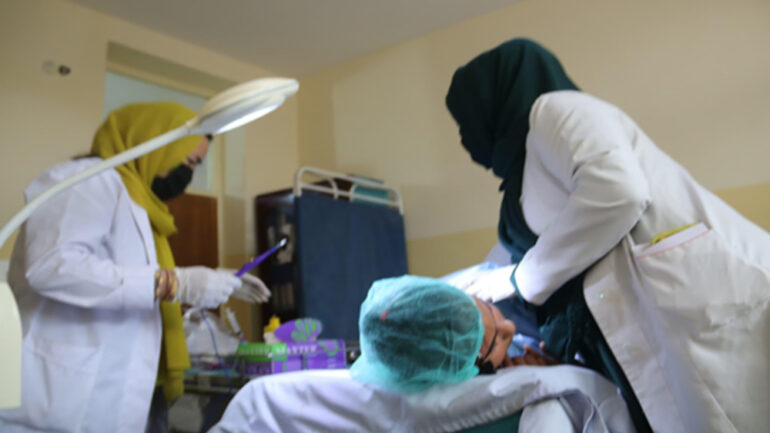
At the same time, the UN warned that restrictions on women and girls under Taliban rule are worsening the humanitarian situation. The ban on girls’ secondary and higher education, along with limits on women’s employment, is creating a severe shortage of female healthcare workers, making it increasingly difficult for women to access essential services such as maternal and neonatal care.
The situation is further compounded by broader structural challenges. UNICEF has warned that Afghanistan could lose more than 25,000 female teachers and health workers by 2030 if current restrictions continue, including 20,000 teachers and 5,400 health workers. The report says these measures are creating a long-term gap in the pipeline of female professionals, weakening both the education and health systems.
Humanitarian agencies reported that between January and April 2026 alone, 5.9 million people received assistance, including 3.5 million who received food aid. However, the UN says sustained and increased funding is urgently needed to address the scale of need across the country.
Women in Afghanistan are currently facing severe and systematic restrictions that have deeply affected nearly every aspect of their lives. Since the Taliban’s return to power in 2021, girls have been barred from secondary and higher education, and women have been largely excluded from many forms of employment, including most public sector roles and NGOs.
Rights groups, UN experts, and activists say the Taliban’s restrictions on the basic rights of women and girls amount to “gender apartheid,” accusing the group of systematically excluding women and girls from public life. Despite international pressure, including appeals from some Muslim-majority countries, the Taliban have not reversed the measures, leaving millions of Afghan women and girls facing an uncertain future.

