

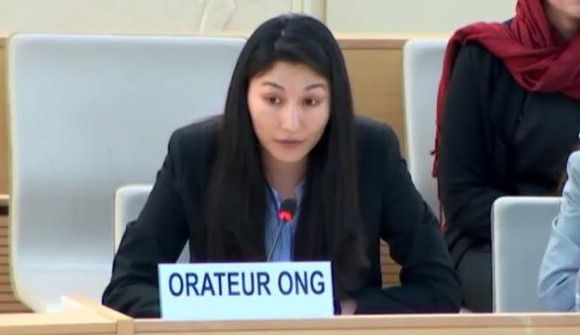

KABUL, AFGHANISTAN – Human Rights Watch (HRW) has called on UN member states to listen to the women and girls of Afghanistan, center their voices, and take stronger action to protect their rights and advance accountability for gender persecution.
Speaking at the 61st session of the UN Human Rights Council on Thursday, Fereshta Abbasi, HRW’s Afghanistan researcher, urged states to recognize “gender apartheid” as a crime against humanity and support International Criminal Court (ICC) efforts to prosecute those responsible for grave international crimes.
Abbasi also called on member states to back initiatives to hold the Taliban accountable for violations of the Convention on the Elimination of All Forms of Discrimination Against Women (CEDAW) at the International Court of Justice and to pursue criminal cases through universal jurisdiction.
She welcomed a new UN investigative mechanism established last October as a key tool for accountability, but urged it be fully operationalized and adequately resourced.
Abbasi said the Taliban have recently passed a new criminal procedure code that deepens repression, defining Muslims exclusively under Hanafi jurisprudence and labeling other religious groups, including Shia, as heretics. She added that the law recognizes only “excessive beating” as domestic violence against women, leaving survivors of other forms of abuse without protection or pathways to justice.
Speaking on behalf of the Asian Forum for Human Rights and Development (FORUM-ASIA), Hafizullah Saeedi said the Taliban have expanded the scope and brutality of their violence and oppression. The Taliban’s new code, he said, codifies discrimination based on social status, gender, and religion, legitimizes slavery, and mandates executions for dissenters and those with differing identities, including members of the LGBTIQ+ community.
Saeedi also drew attention to the ongoing persecution of Hazara and other minority communities, citing repeated ISKP attacks and forced conversions targeting Ismailis. He described the pattern of violence as bearing “hallmarks of genocide.”
He raised concerns over the detention of journalists Mahdi Ansari, Hamid Farhadi, and Nazira Rashidi, who remain in Taliban custody on allegations of propaganda against the regime. Saeedi welcomed the Investigative Mechanism for Afghanistan, saying it offers crucial pathways for accountability, and called for fair and financial support for the mechanism and civil society groups.
Earlier at the council session, Volker Türk, UN High Commissioner for Human Rights, and Richard Bennett, UN Special Rapporteur on human rights in Afghanistan, criticized Taliban laws and policies, particularly the new criminal code, for intensifying repression of women, girls, and other vulnerable groups.
Türk described Afghanistan as a “graveyard for human rights,” citing a series of Taliban decrees that have a “crushing impact” on the Afghan people, especially women and girls, and expressed support for codifying “gender apartheid” as a crime against humanity.
Bennett, presenting his report “Women’s and Girls’ Right to Health in Afghanistan,” said the Taliban have implemented an “institutionalized system of gender-based discrimination, oppression and domination” affecting education, employment, freedom of movement, and access to healthcare, which he said amounts to crimes against humanity.

